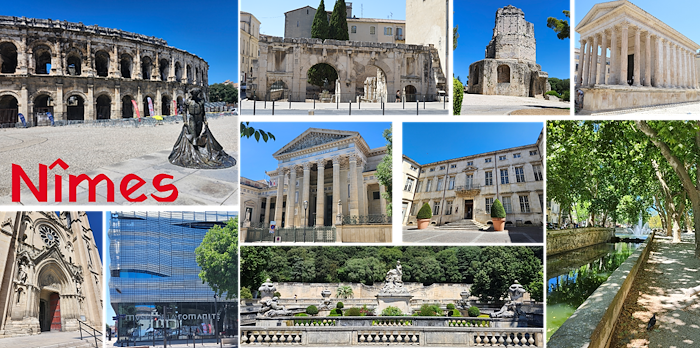
Nîmes is one of southern France’s most captivating cities, where Roman monuments, elegant squares, and refined architecture create a remarkably rich urban landscape. Its heritage is not frozen in the past: the city remains vibrant, walkable, and full of culture, making it an excellent destination for visitors who want both history and atmosphere.
Roman heritage
Nîmes Arena
A masterpiece of Roman engineering, the Arena is among the best-preserved amphitheatres in the world. Still used for concerts and major events, it remains a powerful symbol of the city’s ancient past.
Maison Carrée
This beautifully preserved Roman temple is one of Nîmes’s greatest treasures. Its elegant proportions and perfect preservation make it one of the most admired classical monuments in France.
Tour Magne
Rising above the city, the Tour Magne is the last great remnant of Nîmes’s Roman fortifications.
Porte Auguste
Once a principal gateway into the Roman city, Porte Auguste recalls the scale and prestige of ancient Nîmes. Its remains give a clear sense of the city’s former defensive system.
Augustan city walls
The ancient walls once encircled Nîmes for more than six kilometres. Although only fragments survive, they testify to the city’s importance in Roman Gaul.
Gardens and landscape
Jardins de la Fontaine
Among the earliest public gardens in Europe, the Jardins de la Fontaine combine classical landscaping with ancient ruins. The result is a place that feels both serene and deeply historic.
Temple of Diana
This mysterious Roman structure, nestled within the gardens, is one of the most atmospheric ruins in Nîmes. Its name evokes antiquity, while its weathered stone adds to the charm of the site.
Canal de la Fontaine
The canal reflects the city’s long relationship with water and urban planning. It helps shape the gardens and contributes to their elegance and balance.
Pradier Fountain
Set on a large public square, the Pradier Fountain is a striking example of 19th-century civic ornament. Its monumental form gives the area a refined and theatrical character.
Squares and historic centre
Place du Général de Gaulle
A lively central square, this is one of the places where daily city life is most visible. It brings together movement, urban energy, and the rhythm of the modern centre.
Square Antonin
A calm, landscaped square, Square Antonin offers a quieter pause in the historic centre. Its greenery and statues make it a pleasant stop during a walk through the old town.
Square de la Couronne
This smaller square reflects the intimacy of Nîmes’s historic core. Its setting is ideal for appreciating the atmosphere of the old streets and traditional urban fabric.
Place de l’Horloge
A lively and symbolic square, Place de l’Horloge is one of the main public spaces in the historic centre. Its clock tower, town hall, and surrounding cafés make it a natural meeting point.
Nîmes Cathedral
Nîmes Cathedral combines Romanesque origins with later additions, creating a layered architectural identity. It stands as one of the city’s key religious landmarks.
Saint-Baudile Church
This imposing neo-Gothic church adds a 19th-century dimension to Nîmes’s skyline. Its dramatic style contrasts with the city’s ancient monuments.
Sainte-Perpétue and Sainte-Félicité Church
A major 19th-century church, this building reflects the city’s religious and architectural renewal in the modern era. It is an important part of Nîmes’s historic centre.
Passage Bayle
A narrow covered passage in the old town, Passage Bayle captures the charm of Nîmes’s lesser-known streets. It is the kind of place that rewards slow exploration.
Culture and museums
Musée de la Romanité
Facing the Arena, the Musée de la Romanité presents Nîmes’s Roman past in a modern and immersive way. It is a must-see for anyone interested in archaeology and ancient history. – Free garden and terrasse
Museum of Fine Arts of Nîmes
This museum showcases works from the Renaissance to the modern period. It adds depth to the city’s cultural offer beyond its ancient heritage.
Galerie Jules-Salles
A space for temporary exhibitions, the Galerie Jules-Salles keeps the city’s art scene dynamic and contemporary. It is a useful stop for visitors interested in rotating cultural programming.
Museum of Taurine Cultures
Dedicated to bull culture and local traditions, this museum explores an essential part of Nîmes’s identity. It offers insight into the city’s festive and regional heritage.
Natural History Museum of Nîmes
This museum presents fauna, flora, geology, and scientific collections. It brings a broader natural perspective to the city’s cultural landscape.
Old Nîmes Museum
Focused on everyday life, traditions, and local memory, this museum helps visitors understand the city beyond its grand monuments. It is especially rich for anyone interested in social history.
Civic heritage and memory
Palais de Justice of Nîmes
Inspired by Roman architecture, the Palais de Justice expresses the city’s attachment to classical forms and civic dignity. Its monumental presence reinforces the formal character of the centre.
Nîmes City Hall
The City Hall is the administrative heart of Nîmes and a key civic landmark. Its location and architecture make it a central part of the urban landscape.
War Memorial of Nîmes
This memorial honors the city’s war dead and provides a solemn space of remembrance. It is an important part of Nîmes’s collective memory.
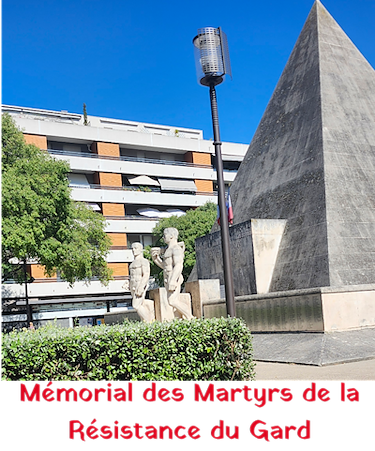
Memorial to the Martyrs of the Resistance of Gard
This pyramid-shaped monument pays tribute to the resistance fighters of World War II. It offers a powerful reminder of the region’s wartime history.
Identity and modern symbols
Carré d’Art
Standing opposite the Maison Carrée, Carré d’Art is a striking contemporary counterpoint to Roman antiquity. Its architecture and museum functions make it one of the city’s best-known modern landmarks.
Bull of Nîmes Sculpture
This sculpture reflects the strong bullfighting and taurine identity of the city. It serves as a bold and recognizable symbol of local culture.
Statue of Nimeño II
A tribute to a beloved bullfighter, this statue connects Nîmes to its popular traditions. It is a meaningful landmark for those interested in the city’s cultural identity.
Statue of Alphonse Daudet
A tribute to the famous Nîmes-born writer, this statue honors his literary legacy in the city. It is a meaningful landmark for those interested in Nîmes’s cultural identity.
Transport and access
Nîmes Railway Station
The historic railway station, with its elegant 19th-century arcades, is one of the city’s main entry points. It combines practical function with architectural character.
Nîmes–Pont du Gard Station
This modern high-speed station improves access to Nîmes and the surrounding region. It is especially useful for visitors arriving by TGV.
Nîmes Tourist Office
Located opposite the Arena, the Tourist Office is the ideal place to start a visit. It offers maps, advice, and orientation for exploring the city.
Heritage stops
Maison natale d’Alphonse Daudet
This literary landmark is tied to the memory of Alphonse Daudet, one of France’s great writers. It adds a cultural and regional dimension to any visit.
Maison-observatoire Benjamin Valz
Associated with the astronomer Benjamin Valz, this site reflects Nîmes’s scientific heritage as well as its architectural history. It is a lesser-known but fascinating stop.
Hôtel Foulc
A distinguished private mansion from the 19th century, Hôtel Foulc reflects the wealth and ambition of Nîmes’s bourgeois elite. Its later association with the Colomb de Daunant family adds another layer to its history.
Hôtel Marquis de la Baume
This elegant 17th-century mansion is one of the finest examples of aristocratic architecture in Nîmes. Today it stands as a refined reminder of the city’s historic private residences.
Did you know
Denim
The story of denim begins in Nîmes, a city renowned for its textile industry since the 16th century. Here, a durable twill fabric called “serge de Nîmes” was produced, known for its strength and diagonal weave. Originally made from wool and silk, it later incorporated cotton, making it more practical for everyday workwear.
Exported across Europe, the name “de Nîmes” gradually evolved into “denim.” In the 19th century, this fabric was adopted in the United States, where Levi Strauss used it to create durable clothing for workers, giving rise to the blue jean.
Over time, jeans moved far beyond their utilitarian origins to become a global icon—worn by all generations and present in every level of fashion. While denim represents an important textile heritage, it also raises modern environmental concerns due to its resource-intensive production.
Today, the name “denim” remains a lasting tribute to Nîmes, linking a local craft to a worldwide cultural symbol.
The 1988 Flood in Nîmes
On October 3, 1988, Nîmes was struck by a sudden and devastating flood caused by an intense Mediterranean storm. In just a few hours, exceptionally heavy rainfall—estimated at over 400 mm locally—overwhelmed the city’s drainage system. The normally dry streams (cadereaux) turned into torrents, rushing through streets and low-lying areas.
The disaster resulted in 10 fatalities and caused extensive damage throughout the city. Thousands of vehicles were swept away, homes and businesses were flooded, and key infrastructure was severely impacted. Water levels rose rapidly in several central areas: the Jardins de la Fontaine overflowed, and floodwaters reportedly reached the lower steps near the Maison Carrée, illustrating the scale of the event in the historic center.
Considered one of the most severe urban floods in modern French history, the event exposed the risks of building over natural waterways. In response, major flood prevention measures were implemented, including retention basins, improved drainage networks, and better management of the cadereaux to reduce future risk.
Reference: Météo-France; French Ministry for Ecological Transition (historical data on the 1988 Nîmes flood).