
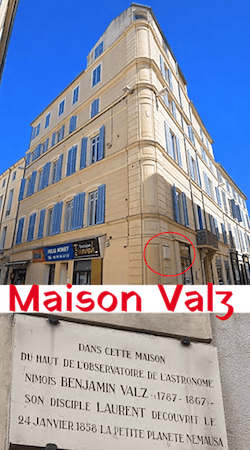
Blending into the urban fabric, the house at 32 rue Nationale in Nîmes preserves an unexpected chapter of the city’s scientific history. Known as the Benjamin Valz Observatory House, it recalls a time when Nîmes was not only shaped by its Roman heritage, but also by a curiosity for the stars.
A site connected to astronomy
In the early 19th century, the astronomer Benjamin Valz established a small private observatory here. Deeply involved in celestial calculations and the study of minor planets, he pursued part of his work in this house before becoming director of the Marseille Observatory in 1836.
After his departure, the observatory continued to be used by other local astronomers.
It was in this modest but well-adapted setting that Joseph Jean Pierre Laurent made a notable discovery. On the night of January 24, 1858, he identified a new celestial body: the asteroid 51 Nemausa, named after Nemausus, the ancient deity associated with the city of Nîmes.
A remarkable discovery
This finding, made from a private observatory, reflects the spirit of 19th-century astronomy, when dedicated individuals—whether professionals or advanced amateurs—contributed to expanding scientific knowledge.
Located in the asteroid belt between Mars and Jupiter, Nemausa remains catalogued and studied today. For this discovery, Laurent received the Lalande Prize from the French Academy of Sciences, one of the most prestigious scientific distinctions of the time.
A discreet trace in the city
Today, little distinguishes the house from its surroundings, aside from a commemorative plaque recalling the discovery. The observatory itself has disappeared, leaving behind an ordinary façade that gives little hint of its scientific past.
An unexpected scientific heritage
Although modest and often overlooked, the site offers a different perspective on Nîmes. Beyond its well-known Roman monuments, the city also played a small role in the exploration of the solar system.
The Benjamin Valz Observatory House stands as a quiet reminder of a time when curiosity, patience, and careful observation could turn even a private residence into a place of discovery.
Translation of the commemorative plaque
French (original)
« Dans cette maison du haut de l’observatoire de l’astronome nîmois Benjamin Valz (1787–1867) le disciple Laurent découvrit le 24 janvier 1858 la petite planète Nemausa. »
English translation
“In this house, from the upper part of the observatory of the Nîmes astronomer Benjamin Valz (1787–1867), Laurent discovered the minor planet Nemausa on January 24, 1858.”

