
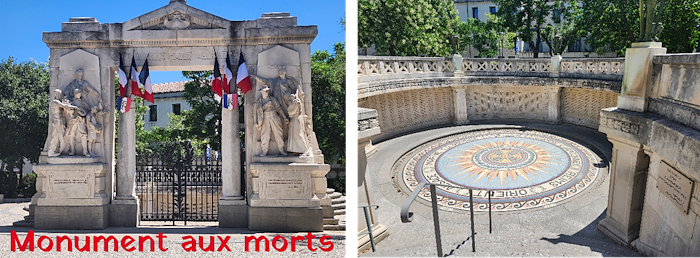
(Monument aux morts de Nîmes)
Located in a small square adjacent to the Esplanade Charles-de-Gaulle, just across a roadway and near the Arènes de Nîmes, the Monument aux morts de Nîmes is one of the city’s main sites of remembrance. Inaugurated on October 12, 1924, in the presence of Gaston Doumergue, a native of the Gard region, it honors those who died for France during the First World War, later including victims of the Second World War and other conflicts.
A symbolic location
The monument stands within a space closely connected to the Esplanade, traditionally a place of gathering and public life in Nîmes. Its slightly set-back position creates a quieter environment, suitable for remembrance, while remaining integrated into one of the city’s central areas.
A sober yet powerful architecture
Unlike many war memorials that rise vertically, this one is partly underground. Visitors enter through a discreet access leading to a large circular chamber below ground level, creating a solemn and introspective atmosphere.
Inside, the walls are engraved with the names of several thousand fallen soldiers, mainly from Nîmes and the surrounding region. A decorative mosaic floor adds a subtle artistic dimension to the space.
Sculptural decoration rich in symbolism
On either side of the entrance, two high-relief sculptures by Auguste Carli frame the monument.
- On the right, The City of Nîmes transmitting the call of the homeland depicts a departure for war, guided by an allegorical figure representing the city.
- On the left, The Victorious Homeland paying tribute to the dead evokes the return and the memory of those who did not come back.
These compositions combine themes of sacrifice, loss, and collective memory.
Beneath the sculptures are engraved lines attributed to Victor Hugo, honoring those who died for their country.
A monument between remembrance and daily life
The Nîmes War Memorial is more than a commemorative structure—it is integrated into the everyday urban landscape. Its discreet yet monumental design encourages quiet reflection rather than grand display.
Today, it remains a central site for ceremonies, particularly on November 11, maintaining a strong link between history, collective memory, and local identity.

