
13 boulevard Amiral-Courbet
Located on Boulevard Amiral-Courbet in the heart of Nîmes, the Jules Salles Gallery is a discreet yet elegant building dedicated to artistic expression. Founded at the initiative of Jules Salles, the gallery was conceived as a cultural space intended to be shared with the public.
A story of art and memory
The project is closely linked to the artistic circle of Jules Salles and, in particular, to the painter Adélaïde Wagner, his wife. Following her death, Salles pursued the realization of the gallery, entrusting its design to the architect Max Raphel.
Inaugurated on May 5, 1894, the building was later donated to the city. It was conceived as a cultural venue intended to host exhibitions and artistic events, in the spirit of late 19th-century spaces where different forms of art could come together.
An expressive and symbolic façade
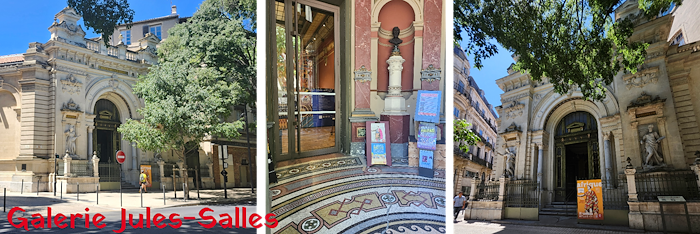
The façade is one of the most distinctive elements of the building. Symmetrical in composition, it is organized around a large semicircular arched entrance framed by columns and pilasters inspired by classical architecture.
On either side of the entrance stand two sculptures by Léopold Morice, representing Painting and Music as female allegorical figures. One holds a palette and brushes, the other a lyre, both depicted in calm, balanced poses.
These allegories, characteristic of 19th-century academic art, are not purely decorative. They express the building’s purpose as a place dedicated to artistic creation and cultural exchange, reflecting the idea of harmony between the arts.
Eclectic architecture of the late 19th century
The gallery is a fine example of late 19th-century eclectic architecture. It combines neoclassical references, sculptural ornamentation, and a structured composition, while allowing for decorative richness.
The use of light-colored stone, typical of Nîmes, enhances the clarity of the façade and highlights its sculptural details. Inside, the space is organized with careful attention to proportions and circulation, creating an atmosphere suited to exhibitions and public reception. The entrance hall notably features a bust of Jules Salles, recalling the figure behind the project.
A living cultural space
Today, the gallery is part of the Muséum d’Histoire naturelle de Nîmes and is primarily used for temporary exhibitions. It continues to fulfill its original role as a place for artistic presentation and public engagement.
A façade that tells its purpose
More than simple decoration, the façade of the Jules Salles Gallery conveys a clear message. Through its architectural language and sculptural program, it reflects the building’s original ambition: to create a space dedicated to art, knowledge, and shared cultural experience.

