
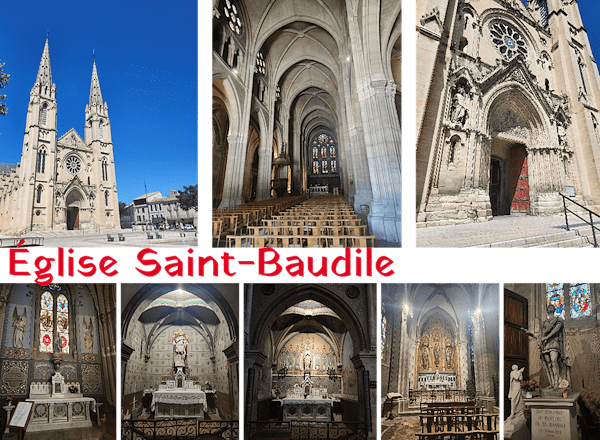
(Église Saint-Baudile)
Located on Place Gabriel-Péri, across from the Porte Auguste, Saint-Baudile Church is one of the most prominent religious buildings in Nîmes. Built in the second half of the 19th century, it stands out for its scale and its twin spires, which rise clearly above the surrounding neighborhood.
A 19th-century church on an older site
The church was constructed between 1867 and 1877 on the site of a former Carmelite convent, during a period of urban expansion beyond the historic center. It was designed by architect Jean-Jules Mondet and consecrated in 1877.
Dedicated to Saint Baudile, the patron saint of Nîmes, the building reflects a desire to connect the city’s religious identity with both its historical roots and its modern development.
A Neo-Gothic landmark
Saint-Baudile Church is a clear example of Neo-Gothic architecture, a style widely used in 19th-century France. Its plan follows a Latin cross layout, with a strong emphasis on verticality.
From the outside, the façade is marked by two slender spires rising to about 70 meters (230ft). Pointed arches, sculptural decoration, and carefully structured volumes give the building a distinctive and recognizable silhouette.
Inside, the space is vast and luminous. High vaults supported by slim columns create a strong sense of height and openness. Stained glass windows—particularly those produced by the workshop of Joseph Villiet—filter the light and contribute to the atmosphere. The organ, built by Aristide Cavaillé-Coll, reflects the importance given to music in the liturgical setting.
A church dedicated to the city’s patron saint
The façade features a statue of Saint Baudile, represented with a sword and a palm, traditional symbols of martyrdom. His presence at the entrance reinforces the church’s dedication and its connection to local history.
Saint Baudile is believed to have lived in the 3rd century and is considered the first evangelizer of the region. According to tradition, he was executed after opposing pagan practices and refusing to take part in Roman religious’ rites.
The legend of the Three Fountains
One of the most enduring traditions associated with Saint Baudile is the legend of the “Three Fountains.” It recounts that after his execution, his head struck the ground three times, and each of these locations later became associated with the “Three Fountains” tradition.
This story is linked to the Oratoire des Trois-Fontaines, located in the Croix-de-Fer district. Restored in the 19th century, this small sanctuary preserves the memory of the saint and reflects the lasting devotion connected to him.
A church still in use today
Saint-Baudile remains an active parish church and is open to visitors. Due to its size and its prominent silhouette, it is sometimes mistaken for the cathedral.
A landmark beyond the historic center
Unlike many of Nîmes’ better-known monuments concentrated in the historic core, Saint-Baudile Church reflects the city’s 19th-century expansion. Its scale and visibility make it an important landmark, linking the older Roman and medieval city with its later urban development.

