
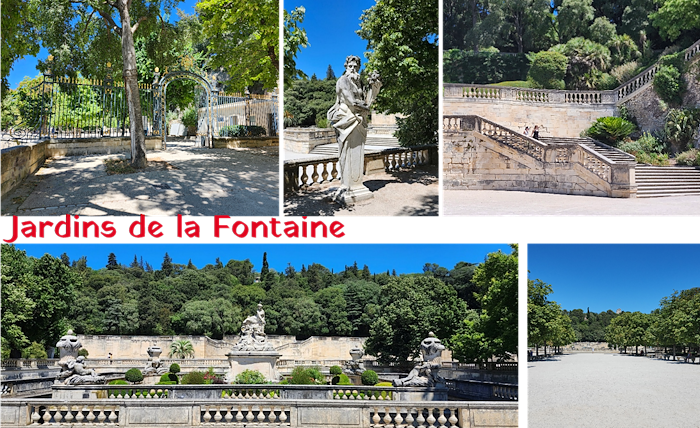
Created in 1745 by royal engineer Jacques Philippe Mareschal, the Jardins de la Fontaine are among the first major public gardens developed in France. Designed around a spring already revered in ancient times, they elegantly combine French formal garden design with the preservation of Roman remains.
A sacred site at the origin of the city
Long before the gardens were created, this area was a major sanctuary dedicated to the god Nemausus, from whom the city takes its name. The Romans built an important religious complex around the spring, making this site central to the birth of Nîmes. Today’s gardens continue this legacy, linking landscape, water, and spirituality across more than two millennia.
Statues, water features, and visual composition
In the lower gardens, the layout follows a classical and symmetrical design. Basins, canals, and monumental staircases structure the space, accompanied by numerous 18th-century statues depicting Apollo, Diana, and nymphs. Water plays a central role, both visually and symbolically, reflecting the aesthetic ideals of the Enlightenment period.
The Temple of Diana, a mysterious relic
At the heart of the gardens stands the Temple de Diane, a structure dating from the 1st century AD. Despite its name, it was likely not a temple, but rather a library or a building connected to the imperial sanctuary. Its partially collapsed vaults and massive walls make it one of the most evocative Roman remains in the city.
The Tour Magne, overlooking the city
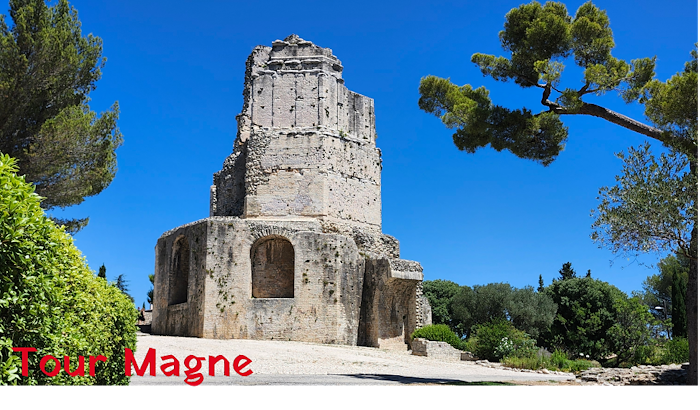
Climbing toward the upper part of the gardens leads to the Tour Magne, a major remnant of the Roman fortifications. Built in the late 1st century BC and later heightened under Augustus, once a watchtower and symbol of Roman power, it rises to about 32 meters (105ft). .
A garden of two atmospheres
Covering around 15 hectares, the gardens are divided into two distinct areas. The lower section reflects the structured, geometric design of the 18th century, while the upper part, developed in the 19th century, offers a more natural and Mediterranean landscape with pine trees, cypress, and shaded paths.
A walk through nature and history
Today, the gardens are both a place to relax and a historical site. Visitors come to stroll, enjoy the shade, and take in the carefully framed views. At every turn, the space reveals a balance between designed nature and traces of the past.
A must-see in Nîmes
More than just a park, the Jardins de la Fontaine are a layered historical landscape where Antiquity, the Enlightenment, and modern developments coexist. Understanding these gardens means understanding the very origins of Nîmes — a city born from water and shaped by its Roman heritage.



Great information about the destination.
LikeLike