
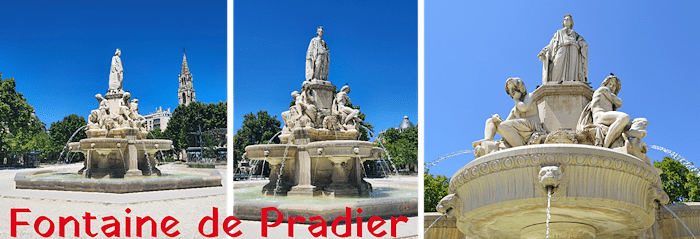
At the heart of the Esplanade Charles-de-Gaulle, the Pradier Fountain has stood since 1851 as one of the city’s most recognizable landmarks. Elegant and animated by flowing water, it reflects the refinement of the 19th century while echoing Nîmes’ long-standing relationship with water, a defining element of its history since Antiquity.
A fountain to structure an open urban space
Commissioned in 1844 under Mayor Ferdinand Girard, the fountain formed part of a broader urban renewal project aimed at organizing and enhancing the Esplanade. This transformation accompanied the modernization of Nîmes in the 19th century, particularly with the arrival of the railway and the development of the station district.
The project was entrusted to architect Charles Questel and sculptor James Pradier, whose collaboration resulted in a balanced composition combining architecture and sculpture.
A sculptural composition rich in symbolism
The fountain is organized around a central basin animated by cascading water. Bronze lion-head spouts and tiered elements create movement and sound, bringing life to the monument.
At the top stands a female allegorical figure representing Nîmes, crowned with elements evoking its Roman heritage, including references to the Arènes and the Maison Carrée. Around her, four seated figures symbolize the importance of water in the region, traditionally associated with local rivers and the historic Nemausus spring.
These figures, inspired by classical antiquity, are depicted with attributes such as urns and flowing water, representing abundance, continuity, and the natural forces that shaped the city.
A mineral setting shaped by light
The fountain stands within a vast, largely open esplanade characterized by a strong mineral presence. The immediate surroundings are defined by wide paved surfaces exposed to full sunlight, where shade can be limited depending on the season and time of day.
This contrast enhances the visual presence of the fountain: the movement and freshness of water stand out against a bright, dry setting. In the background, the silhouette of the Arènes provides a powerful architectural frame, reinforcing the dialogue between classical heritage and 19th-century urban design.
A symbol of a transforming city
Installed during a period of major urban change, the fountain reflects a city redefining its public spaces while preserving its historical identity. It became a central feature within the newly structured Esplanade.
A lively meeting point today
Now protected as a historic monument, the Pradier Fountain remains an important gathering point. Its open setting, combined with its proximity to the Arena and main pedestrian flows, makes it a natural point of passage and pause within the city.
 Simple Travel and Recreation