
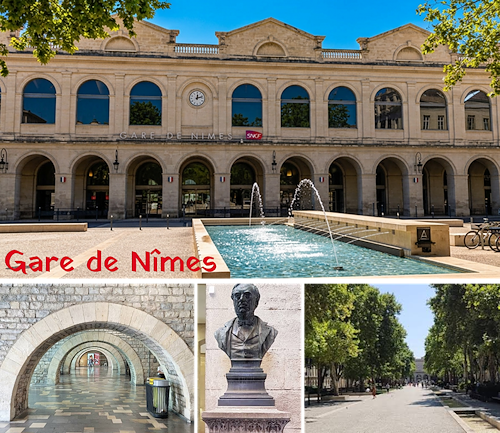
(gare de Nîmes)
Located just steps from the historic centre, the Gare de Nîmes is much more than a transport hub. Opened in the 1840s, it is one of the earliest railway stations still in operation in France and has played a central role in the city’s transformation.
When the railway arrived, it marked a turning point for Nîmes. Already a thriving textile and trading centre, the city quickly expanded as goods and travellers moved more efficiently across the region. The train helped reinforce Nîmes’ position within networks linking the Mediterranean, the Rhône Valley, and beyond.
The arrival of the railway
The development of the railway in Nîmes is closely tied to Paulin Talabot, a key figure in southern France’s rail expansion.
As early as 1839, a line connected Nîmes to Beaucaire, soon followed by routes to Montpellier and the Cévennes mining basin. The first station was a simple structure, later replaced by the more monumental building that still stands today.
A monumental 19th-century façade
Built between 1842 and 1844, the station reflects a restrained neoclassical style inspired by antiquity. Its long, symmetrical façade—stretching roughly 100 metres—is punctuated by about nineteen large arcades arranged over two levels.
Constructed in local limestone and designed with balance and clarity, the building echoes the architectural language that defines Nîmes, particularly the nearby Arènes de Nîmes. Without excessive decoration, it conveys both solidity and elegance, embodying the civic pride and modern ambition of the railway age.
The viaduct: an engineering landmark
Behind the station stretches a remarkable railway viaduct designed by engineer Charles Didion in the 1840s.
Extending for approximately 1.6 to 1.8 kilometres and carried by nearly 200 stone arches, it crosses the city from east to west. This structure allowed trains to pass through Nîmes while maintaining the continuity of streets below—an elegant and forward-thinking solution for its time.
A city reshaped
The station did not just bring trains—it reshaped the city itself. Avenue Feuchères, created in the 1840s, forms a direct link between the station and the historic centre. Broad and carefully planned, it quickly became one of Nîmes’ main urban axes, lined with elegant façades and townhouses.
Around it, new districts developed along Boulevard Talabot and Avenue Carnot, reflecting the expansion of the city during the 19th century. These streets still structure this part of Nîmes today, illustrating how the railway influenced both movement and urban form.
A station in use today
Today, the station remains a lively gateway, welcoming several million passengers each year and handling a steady flow of regional and long-distance trains. It offers direct connections to cities such as Paris, Marseille, Montpellier, and even Barcelona.
It operates alongside the newer Nîmes–Pont du Gard station, opened in 2019 outside the city, but continues to serve as the main and most accessible station for everyday travel.
A lasting presence
Blending classical architectural forms with early industrial ambition, the Nîmes railway station stands as both a functional space and a historical landmark. From its arcaded façade to its sweeping viaduct, it quietly tells the story of a city transformed by the arrival of the railway—where heritage and daily life continue to meet.

