
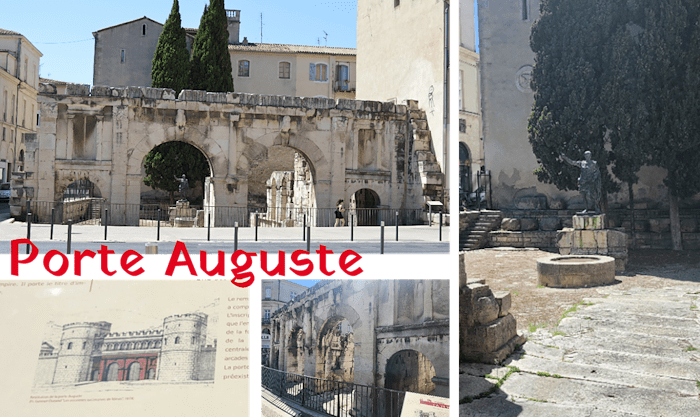
(Porte Auguste)
A powerful reminder of the ancient city, the Porte Auguste has stood at one of Nîmes’ main entrances for over two thousand years. Built around 16 B.C., during the reign of Augustus, it once formed part of the Roman city of Nemausus and opened onto the Via Domitia—a major route linking Italy to Hispania. Passing through it meant entering a structured and thriving Roman city.
From the Gate of Arles to the Auguste Gate
Originally known as the Gate of Arles (Porta Arelatensis), it took its name from the road leading toward Arles.
The name “Auguste Gate” only became established in the 19th century, when renewed archaeological interest brought attention to its Latin inscription. This text states that Augustus “gave the gates and walls” to the colony, highlighting his role in shaping and promoting the development of Nemausus.
A monumental and strategic gateway
The gate once formed part of a defensive wall stretching about 6 km around the city. It featured four openings: two wide central arches for vehicles and two narrower side passages for pedestrians.
Flanked by towers now lost, it functioned both as a point of control and as a symbolic threshold. Here, movement was guided, observed, and, at times, regulated—along one of the region’s most important routes.
Architecture with presence
Built in finely cut stone, the façade is carefully organized, combining strength and balance. Pilasters, blind arches, and sculpted details structure the elevation, while the proportions give the whole a sense of clarity and order.
Beyond its defensive function, the gate also conveyed an image: that of a city aligned with Roman power, stability, and urban sophistication.
A monument revealed over time
During the Middle Ages, the gate was absorbed into later constructions and gradually disappeared from view. Rediscovered and cleared between the late 18th and early 19th centuries, it was recognized as a historic monument in 1840. Today, it stands once again as a visible and integral part of the urban landscape.
The statue of Augustus
Near the gate, a statue of Augustus reinforces the link between the monument and the emperor who shaped the development of Nîmes. Installed in the 20th century and inspired by classical models such as the Augustus of Prima Porta, it presents him in the pose of the imperator—both military leader and political authority.
He is shown wearing a cuirass and a paludamentum (military cloak), symbols of power, protection, and imperial order. His raised arm, in the gesture of adlocutio, evokes the act of addressing troops or the people, suggesting both command and guidance.
Placed beside the Porte Auguste, the statue recalls Augustus’ role in the development of Nemausus and strengthens the symbolic meaning of the site. More broadly, it reflects the lasting Roman identity of Nîmes and its connection to the imperial past.
An enduring landmark
Today, the Auguste Gate remains one of the best-preserved Roman gates in France. More than a surviving structure, it marks a point of passage between past and present—an enduring trace of the city’s origins and its place within the Roman world.
 Simple Travel and Recreation