
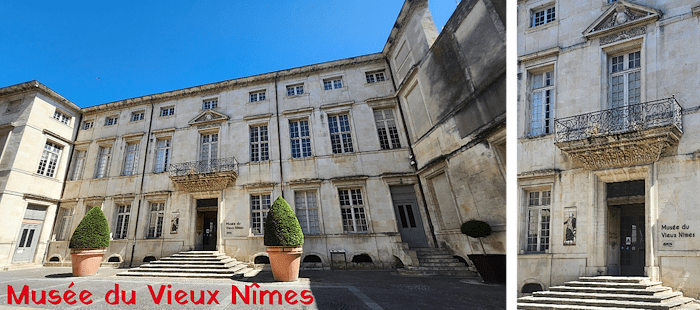
(Musée du Vieux Nîmes)
Founded in 1920 on the initiative of Henri Bauquier, the Musée du Vieux Nîmes brings together tens of thousands of objects. Its collections trace everyday life in Nîmes from the Middle Ages to the modern era, through textiles, ceramics, furniture, and archival materials.
Collections and highlights
The museum explores several themes closely linked to local identity:
- The denim room: highlighting the origins of serge de Nîmes, the fabric that inspired denim later popularized by Levi Strauss.
- Period-style interiors: evoking bourgeois living spaces from the 18th and 19th centuries, with furniture and everyday objects.
- Textiles and lace: reflecting a once-thriving local industry, including the famous Nîmes shawls exported across Europe.
An episcopal palace shaped by religious conflict
The museum is housed in the former bishops’ palace, rebuilt between 1682 and 1685 under the authority of Louis XIV. This reconstruction followed the destruction of the earlier building during the Michelade, a major episode of the French Wars of Religion.
At that time, Nîmes was a Protestant stronghold within a largely Catholic region. On September 29, 1567, numerous Catholic figures—both religious and civic—were killed during an uprising, and the episcopal palace was looted and burned, symbolizing the collapse of Catholic authority in the city.
A reconstruction with strong symbolic meaning
The rebuilding of the palace in the 17th century was both practical and symbolic. It reflected a clear intention to reassert Catholic presence and authority after the conflicts. The building remained the residence of the bishops until the 19th century.
Refined classical architecture
The palace reflects a classical architectural style, with a symmetrical façade organized around a central section. Its design evolved over time, incorporating decorative elements and interior features that illustrate successive phases of construction and adaptation.
Listed as a historic monument, the building still preserves significant elements of its original structure.
A concise and accessible visit
The museum can typically be explored in about 30 to 45 minutes. Temporary exhibitions regularly complement the permanent displays, offering renewed perspectives on the history and identity of Nîmes.

