
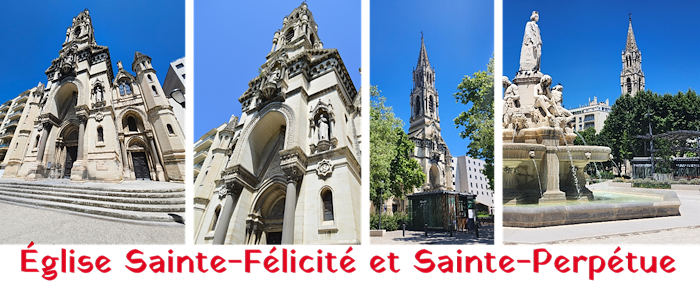
Overlooking the Esplanade Charles-de-Gaulle, the Sainte-Perpétue-et-Sainte-Félicité Church is one of the most visible religious landmarks in the city center. Located near the courthouse, it stands out through its slender silhouette and its bell tower rising to about 70 meters, making it a defining element of the urban skyline.
A site shaped by successive religious uses
The location has hosted places of worship since at least the early Middle Ages. Over time, different religious buildings occupied the site, including a Capuchin convent in the 17th century.
The present church was built between 1852 and 1864, based on plans by architect Léon Feuchère. The foundation stone was laid in 1852 under Napoléon III (then Louis-Napoléon Bonaparte), and the church was consecrated in 1864.
An eclectic 19th-century architecture
The building reflects the eclectic spirit of the Second Empire, drawing primarily on Neo-Gothic forms while incorporating broader historical influences.
Its façade, structured by arches and slender columns, emphasizes verticality. A circular window contributes to the balance of the composition, while the tall spire—topped with a cross—reinforces the upward movement and its strong visual presence from the esplanade.
A carefully composed sculptural façade
The façade features a coherent sculptural program, largely executed by Joseph Félon, with contributions from Auguste Bosc.
Above the main entrance, a central figure of Christ dominates the composition, expressing authority and redemption.
On either side of the portal stand statues of Perpetua and Felicity, each holding the palm of martyrdom, symbolizing their faith and sacrifice.
Higher on the façade, sculpted figures and decorative elements complete the ensemble, while the tympanums of the side doors depict the four Evangelists. Together, these elements form a structured and symbolic composition, typical of 19th-century religious architecture.
An unusual dedication: Perpetua and Felicity
The church is dedicated to two early Christian martyrs, Perpetua and Felicity, who were executed in Carthage in 203 under the reign of Emperor Septimius Severus.
Their story is notable for several reasons. Perpetua was a young noblewoman who had recently converted to Christianity, while Felicity was her servant and was pregnant at the time of her imprisonment. According to early accounts, she gave birth shortly before their execution.
Refusing to renounce their faith, both were condemned to die in the arena. Their shared fate—uniting a free woman and a slave—became a powerful symbol of spiritual equality in early Christian communities. A text attributed in part to Perpetua herself is considered one of the earliest known Christian writings by a woman.
A living place within the city
Still active as a parish church, the building continues to host religious services and welcomes visitors, particularly during heritage events.
Its position between the esplanade, the courthouse, and the main urban routes places it within a coherent urban ensemble, linking public space, civic institutions, and religious heritage.
A visible landmark with enduring meaning
More than just a place of worship, the church plays a key role in the visual identity of Nîmes. Its vertical silhouette contrasts with the horizontal lines of nearby public spaces, creating a strong presence in the cityscape.
It reflects both the religious life of the 19th century and the continuity of a site shaped by centuries of devotion and transformation.

