
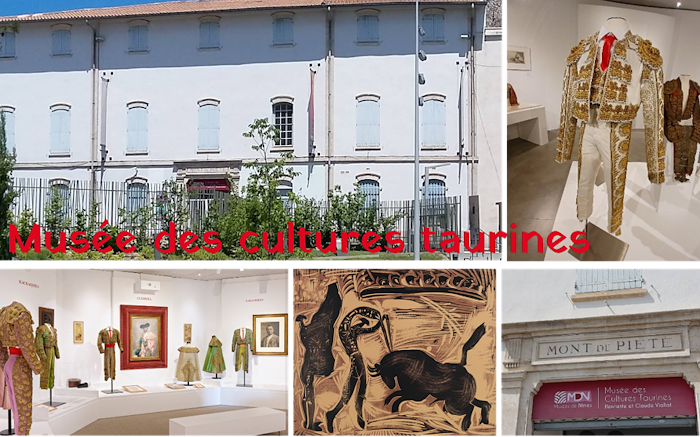
(Musée des cultures taurines)
Located just steps from the Arènes de Nîmes, the Museum of Bullfighting Cultures offers insight into a tradition deeply connected to the identity of Nîmes. Here, the bull is more than an animal—it represents a cultural symbol shaped by history, ritual, and regional life.
A unique museum in France
Opened in 2002, the museum is among the first in France dedicated entirely to bullfighting cultures, and remains one of the most important on this subject. It houses a rich collection of tens of thousands of objects: posters, artworks, costumes, photographs, videos, and everyday items.
Through these collections, the museum explores two closely connected traditions:
- Spanish bullfighting,
- the Camargue bull tradition, specific to southern France.
Together, they illustrate a shared cultural heritage rooted in the region.
The building: the former Mont-de-Piété
The museum is housed in a historic building whose façade still bears the inscription Mont-de-Piété. Established in the 17th century, a Mont-de-Piété was a charitable public institution that provided small loans to people in need in exchange for pledged objects. Created to combat usury, it played an important social role by offering more accessible financial assistance. These institutions later evolved into what are now known in France as the Crédit municipal. The building has since undergone several transformations before being repurposed as a museum, while still preserving traces of its original function.
Between art, history, and living traditions
The museum is organized across several levels:
- permanent galleries explain the history, rituals, and codes of bullfighting;
- temporary exhibitions offer renewed perspectives each year.
It highlights major figures such as José Tomás, one of the most influential contemporary matadors, known for his rare appearances in Nîmes and his strong connection with the local audience.
Works by artists including Francisco de Goya, Pablo Picasso, and Claude Viallat underline the artistic dimension of bullfighting.
A place deeply rooted in its territory
The museum explains how the relationship between people, bulls, and the Camargue landscape has evolved over time. This cultural and festive connection remains a defining feature of local identity.
A symbol that sparks debate
Bullfighting continues to generate debate today. While some view it as controversial, others consider it an integral part of regional heritage.
The museum does not take a position but provides context to better understand its historical and cultural significance.
A visit in rhythm with the ferias
The museum reflects the rhythm of local festivals, particularly:
- the Pentecost Feria (late May or early June),
- the Harvest Feria (typically in September).
Visiting during these periods offers a fuller understanding of the traditions presented.
A modest but pleasant setting
Set in a human-scale building, the museum offers a clear and accessible layout. An inner courtyard inspired by Andalusian patios provides a calm and refreshing pause during the visit.
In summary
The Museum of Bullfighting Cultures is:
- one of the main museums in France dedicated to bull traditions,
- a rich collection blending art, history, and heritage,
- a subject both deeply rooted and widely debated,
- an experience that encourages understanding without requiring agreement.
Bullfighting in the urban landscape
The presence of bullfighting extends beyond the museum into public space. Nearby, the Place Charles-de-Gaulle features a stone bull sculpture, along with a statue of Nimeno II, one of the city’s most iconic matadors.
Together, these monuments reinforce the visible and lasting role of bullfighting in the cultural identity of Nîmes.

