
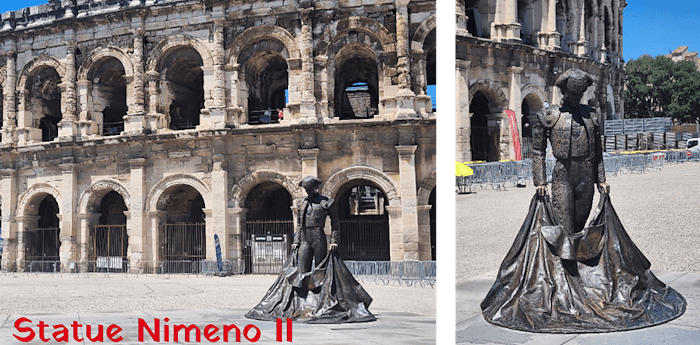
It is difficult to approach the Arènes de Nîmes without noticing the statue of Christian Montcouquiol. Installed in 1994, this bronze sculpture pays tribute to one of the most renowned figures of French bullfighting, whose memory remains closely tied to the city.
A torero turned legend
Born in Nîmes into a Catalan family, Christian Montcouquiol became known in the arena as Nimeño II. Like many bullfighters, he adopted a stage name (known as an apodo), a long-standing tradition in bullfighting culture. These names often refer to a place of origin, a personal trait, or a lineage—in this case, “Nimeño” highlights his connection to Nîmes.
Under this name, he rose to become a leading figure in French bullfighting. On May 14, 1989, he achieved one of his greatest feats by facing six bulls in a single day, a performance that secured his place in local memory. A severe injury later that year in Spain abruptly ended his career, leading to a difficult period that culminated in his death in 1991.
An elegant and expressive sculpture
Created by sculptor Serena Carone, the statue stands over two meters tall and presents the torero in a composed, almost introspective stance. Dressed in the richly detailed traje de luces (“suit of lights”), he appears both dignified and vulnerable.
The careful rendering of the costume—embroidered jacket, fitted trousers, and traditional posture—gives the figure a refined presence. The sculpture captures a suspended moment, emphasizing grace, discipline, and ritual rather than action. This stillness creates a strong impression: the figure seems deeply connected to the place, as if in quiet dialogue with the arena behind him.
A meaningful location
Positioned directly in front of the arena, the statue occupies a highly symbolic location. It stands at the threshold of the space where Nimeño II experienced his greatest triumphs, establishing a direct link between the man and the monument.
Visitors naturally encounter the statue on their way to the arena, making it both a point of passage and a moment of reflection—an introduction to the cultural identity of the site.
Between memory and living tradition
Over time, the statue has become a place of remembrance. Frequently touched by visitors, parts of the bronze have developed a smooth patina, reflecting a lasting public attachment.
It also points to a tradition that is still present in Nîmes today, with events regularly held in the arena, maintaining a connection between past and present.
A symbol between heritage and debate
The statue of Nimeño II embodies both local pride and a broader cultural conversation. It reflects the deep-rooted presence of bullfighting in Nîmes while also recalling the life of a man admired for his talent, elegance, and complex legacy.

