
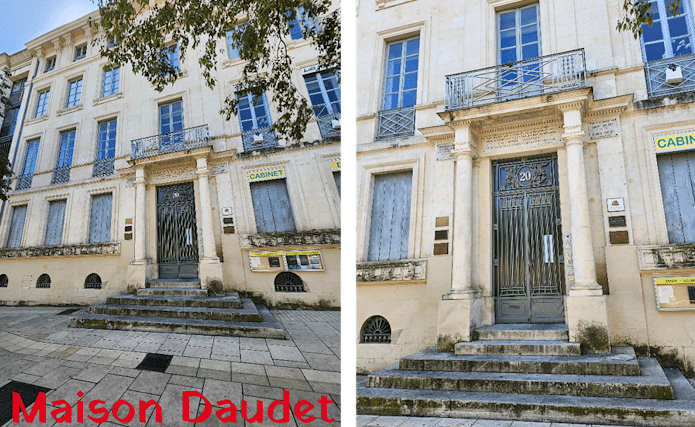
A discreet yet meaningful site in the city, the birthplace of Alphonse Daudet offers insight into the early life of one of France’s most beloved 19th-century authors.
A bourgeois house in the heart of Nîmes
Located at 20–24 boulevard Gambetta (formerly known as the Grand Cours), the house—often referred to as the Maison Sabran—is a 19th-century bourgeois townhouse where Daudet was born on May 13, 1840. Situated in what was then a lively district of silk merchants, it reflects the economic and social environment in which he spent his early childhood.
The building itself remains private and is not open to visitors, but a commemorative plaque on the façade recalls the writer’s memory, bearing his famous words: “I know only one thing: to cry out to my children—Long live life!”
Family background and early years
Daudet was the son of Vincent Daudet, a silk manufacturer, and Adeline Reynaud, both originally from the Cévennes region. He lived in this house until the age of nine, when his family left Nîmes for Lyon following financial difficulties. Despite this relatively short stay, the city left a lasting impression on him, particularly its Roman monuments and southern atmosphere, which would later influence his writing.
A lasting tribute in the city
Nîmes continues to honor its famous native through several sites:
- The Lycée Alphonse-Daudet, a major educational institution bearing his name, reflects his importance in French literary heritage.
- A statue of the writer stands in the Square de la Couronne, inaugurated in 1900 in the presence of his family. This monument serves as the city’s principal tribute, located near the historic center and accessible to visitors.
A discreet but meaningful stop
While the house itself cannot be visited, it remains an important symbolic landmark. It anchors Daudet’s legacy in the urban fabric of Nîmes and complements other literary and cultural sites across the city. For those interested in French literature, it offers a tangible connection to the early life of the author of Letters from My Mill and to the environment that helped shape his imagination.

