
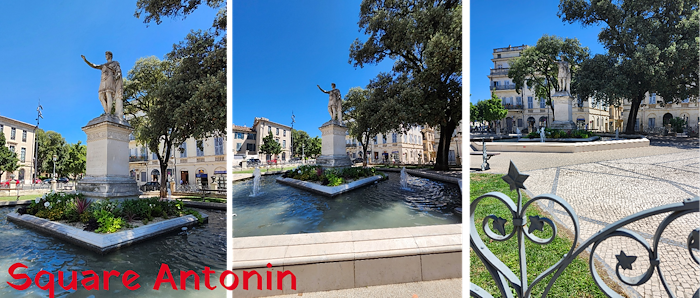
Square Antonin is located northwest of the historic Écusson district, at the junction of Quai de la Fontaine and Boulevard Alphonse-Daudet. It marks an important transition between the old town and the approach toward the Jardins de la Fontaine. Created in 1862–1863, it occupies the site of a former watering basin and lies at the extension of the Canal de la Fontaine, which was restructured during major 18th- and 19th-century urban works aimed at improving sanitation and regulating water flow.
A structured and refined space
The square was designed as an enclosed public garden. It is surrounded by an elegant wrought-iron fence produced by local metalworker Marius Nicolas, based on plans by architect Henri Révoil. Inside, shaded walkways, trees, and benches create a calm and pleasant environment, offering a quiet space just steps away from the busy city center.
The statue of Antoninus Pius at its center
At the heart of the square stands a Carrara marble statue of the Roman Emperor Antoninus Pius. It was sculpted by Nîmes artist Auguste Bosc and inaugurated in 1874. The pedestal bears Latin inscriptions, including Senatus Populusque Nemavensis (“the Senate and the people of Nîmes”). The emperor is represented in a classical stance inspired by Antiquity, reinforcing the city’s strong Roman identity.
An emperor linked to Nîmes
Antoninus Pius (138–161 AD) belonged to a family originating from Nemausus, the ancient name of Nîmes. His reign is associated with stability and continuity within the Roman Empire, during the period of the “adoptive emperors,” between Hadrian and Marcus Aurelius.
A place between history and everyday life
Today, Square Antonin functions as a peaceful public space used by both residents and visitors. Located at the start of the Canal de la Fontaine and on the way to the Jardins de la Fontaine, it serves as both a natural passageway and a place to pause, where Roman heritage, 19th-century urban planning, and modern city life intersect.
A landmark within the city
Square Antonin reflects how Nîmes integrates its Roman past into its modern urban landscape. Its development is directly linked to the Canal de la Fontaine system and 19th-century sanitation works that reshaped this part of the city. It remains both a historical site and a living public space.
 Simple Travel and Recreation