
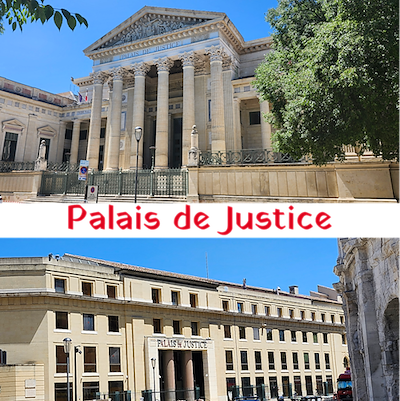
(Palais de Justice)
Located between the Esplanade Charles-de-Gaulle and the Arènes de Nîmes, the Courthouse of Nîmes stands on a site long associated with authority and public life. Its position, at the edge of the historic center, reflects a continuity of administrative and judicial functions that dates back several centuries.
A site of long-standing civic authority
Before the current building, the site was already linked to power and governance. It successively housed important administrative institutions, including judicial bodies under the Ancien Régime.
This continuity is not incidental: it reflects the role of this part of the city as a place where authority—whether royal, civic, or judicial—has long been exercised.
A neoclassical building inspired by antiquity
The present courthouse was built between 1836 and 1846 by architect Gaston Bourdon. It is a clear example of 19th-century neoclassical architecture, directly inspired by the nearby Maison Carrée.
Its monumental façade adopts the codes of an ancient temple: a Corinthian colonnade, a triangular pediment, and strict symmetrical proportions. This reference to antiquity was deliberate, associating justice with ideals of order, permanence, and civic virtue.
Rather than competing with the Roman monuments around it, the building establishes a visual dialogue with them, reinforcing the sense of continuity between past and present.
A building still in use
The courthouse remains an active judicial center, housing several courts. Access is therefore regulated, and the interior cannot generally be visited freely.
However, some spaces may be accessible during public hearings or special events, offering occasional insight into a building that continues to serve its original purpose.
Layers beneath the surface
Beneath the courthouse lies an archaeological crypt preserving earlier remains, including medieval structures linked to the former Château Narbonnais.
Although only accessible during specific openings, such as heritage events, these remains highlight a key characteristic of Nîmes: a city built in layers, where each period leaves traces beneath the next.
A strong presence in the city
The courthouse may not be the most visited site in Nîmes, but it is certainly one of the most imposing. Its façade, inspired by a classical temple, creates an immediate sense of order and authority
Even without access to the interior or the underground remains, the building leaves a lasting impression. It is one of those places where simply standing in front is enough to understand its role and significance.
 Simple Travel and Recreation