
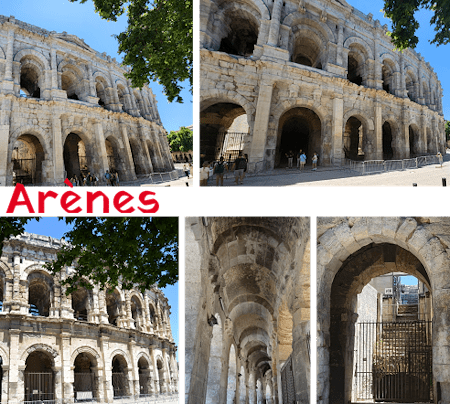
(L’Arène de Nîmes)
In the heart of Nîmes, the Arena stands as one of the best-preserved Roman amphitheatres in the world. Built at the end of the 1st century AD, likely under the Flavian dynasty, it reflects the importance of the ancient city of Nemausus. With a capacity of around 24,000 spectators, it once hosted large crowds gathered for spectacular events at the center of Roman social and political life.
A mastered and functional architecture
The structure impresses with its proportions: about 133 meters (436ft) long, 101 meters (331ft) wide, and 21 meters (68ft) high. Its elliptical façade is composed of two tiers of 60 arcades each, creating a sense of balance and rhythm.
Inside, a sophisticated network of corridors, staircases, and vomitoria ensured smooth circulation of spectators according to social rank. This efficient layout highlights the advanced engineering skills of the Romans.
Spectacles serving Roman power
The Arena was designed for public entertainment, including gladiator fights, animal hunts (venationes), and various performances. Lions, panthers, and bears could be brought into the arena to impress the audience.
Beyond entertainment, these events symbolized Rome’s dominance and control over nature and distant territories.
A site shaped by major historical events
The history of the Arena extends far beyond Antiquity. From the 5th century onward, it was transformed into a fortress to protect the population during invasions. In the Middle Ages, it became a fortified district with houses, towers, and even a chapel, housing several hundred inhabitants.
A major turning point came in the 19th century, when these constructions were gradually removed to restore the monument to its original Roman appearance. This marked the beginning of its recognition as a major heritage site
A monument still alive today
Today, the Arena continues to host major events. Concerts, historical reenactments such as the Great Roman Games, and large gatherings like the Feria de Nîmes take place here every year.
Bullfighting events, although sometimes debated, are also part of the local cultural tradition.
An immersive visitor experience
Visitors can explore the seating tiers, the central arena, and the inner galleries, supported by educational tools that help bring the site to life. From the upper levels, panoramic views offer a broader understanding of the city’s layout.
A key witness to Nîmes’ heritage
More than just an ancient monument, the Arena illustrates a rare continuity: a Roman entertainment venue, a medieval fortress, a restored historic site, and a modern cultural stage.
It stands as a powerful example of how architecture can endure through time while remaining deeply connected to urban life.

