
(Musée des Beaux-Arts)
Tucked away just a short walk from the Arènes de Nîmes, the Musée des Beaux-Arts de Nîmes is one of the city’s major cultural institutions. Founded in 1821 and installed since 1907 in a building designed specifically for its collections, it offers a different perspective from the nearby Musée de la Romanité, focusing on European painting and art from the 15th to the 20th century.
A journey through several centuries of art
The museum brings together around 3,800 works, offering a rich overview of artistic production across Europe. Italian, Northern European, and French schools are all represented, with artists such as Bassano, Mola, Pannini, Rubens, De Heem, Natoire, Boucher, and Delaroche.
Rather than overwhelming visitors, the collections are presented in a clear and accessible way, allowing each period and style to be understood at its own rhythm.
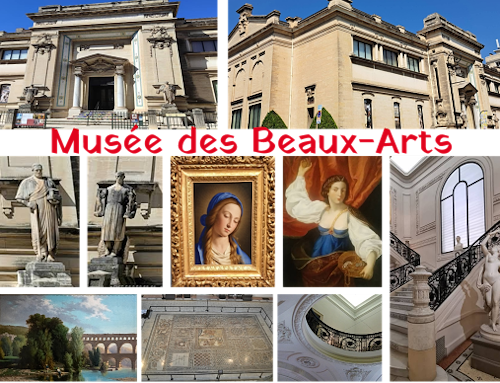
Among the highlights are a glazed terracotta Madonna from the workshop of Andrea della Robbia, works by Charles-Joseph Natoire, and, at the very heart of the building, the remarkable Wedding of Admetus mosaic. This large Roman mosaic, displayed in the central atrium, creates a striking link between fine arts and the city’s ancient past.
The museum also preserves a selection of works by Jules Salles and Adélaïde Salles-Wagner, offering a glimpse into Nîmes’ local artistic heritage.
A building designed to enhance the visit
The museum is housed in an elegant early 20th-century building designed by the architect Maximilien Raphel. Conceived as a “temple of art,” it combines a classical façade with a clear and balanced interior layout.
At its center, a large glass-roofed atrium brings in natural light and organizes the visit around a calm, open space. The galleries, arranged over two levels, follow an easy-to-navigate progression.
This architectural clarity plays an important role: it allows the artworks to be appreciated without distraction, in a setting that feels both structured and welcoming.
A carefully restored museum
In 1987, architect Jean-Michel Wilmotte led a major renovation, modernizing the museum while preserving its original character. Particular attention was given to light, circulation, and the overall viewing experience.
On the exterior, allegorical sculptures representing Painting and Sculpture subtly recall the building’s purpose and reinforce its identity as a place dedicated to the arts.
A museum between tradition and modernity
Discreet from the outside, the Museum of Fine Arts reveals a rich and balanced experience once inside. Its strength lies in the coherence between its architecture and its collections, offering a visit that is both calm and rewarding.
It provides a valuable complement to the city’s Roman heritage, showing another layer of Nîmes’ cultural identity—one shaped not only by antiquity, but also by centuries of artistic creation.

