
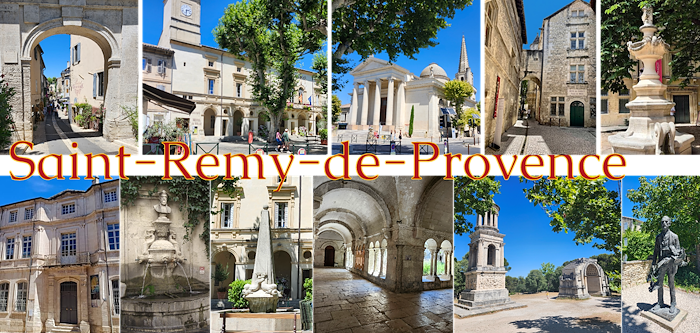
In the heart of the Alpilles, Saint-Rémy-de-Provence has that rare ability to slow time down. The moment you pass through the Saint-Paul Gate, something changes almost instantly. The light feels softer, the stone warmer — understandable, you might say, in the middle of July — yet there is also something else, something harder to explain. Between the honey-colored façades, the plane trees rustling in the breeze, and the lively terraces filled with the sound of southern conversations, the village radiates an atmosphere that is at once elegant, peaceful, and deeply Provençal. Here, you do not simply visit a place; you step into a different rhythm.
Little by little, the noise of the outside world fades away, replaced by the murmur of fountains, the echo of footsteps on cobblestones, and the scent of thyme carried through the warm air. It feels as though you are passing from one world into another, as if the village had preserved an invisible boundary between modern Provence and an older, almost timeless Provence.
Saint-Rémy never fully reveals itself at first glance. Its narrow streets seem designed to slow your pace, draw your eyes elsewhere, and invite you to wander. Behind a half-open door, at the end of a discreet courtyard, or beneath the shade of a vaulted passageway, hidden places suddenly appear — quiet, unexpected, almost secret. The village seems to protect part of itself from hurried visitors, as though its greatest treasures could only be discovered by chance.
Perhaps that is what makes Saint-Rémy-de-Provence so captivating: the constant feeling of existing between two worlds, between light and stone, history and the sweetness of life, movement and silence. The soft tones of the village’s stone façades contrast beautifully with the vibrant colors spilling from shop displays and market stalls. A village that never tries to impress, yet slowly, gently, begins to live within you.
What can you find/see in Saint-Remy-de-Provence:
1. Village Heart and Old Streets
• Place Favier: A lively small square in the historic center, surrounded by cafés and typical Provençal façades.
• Place Jules-Pellissier (Place of the Hotel de ville): A shaded square appreciated for its peaceful atmosphere and terraces in the heart of old Saint-Rémy.
• Place Philippe-Latourelle: A charming discreet square lined with old houses and small local shops.
• Place Jean Jaurès: A large central square often animated by village markets and events.
• Place Joseph Roumanille: A square dedicated to the Provençal poet Joseph Roumanille, an important figure of regional culture.
• Saint-Paul Gate: Former gate of the medieval ramparts marking the historic southern entrance to the town.
• Porte du Trou: A remaining section of the medieval fortifications, recalling Saint-Rémy’s defensive past.
2. Present and Former Sacred Sites
• Collégiale Saint-Martin: Large 19th-century neoclassical church holding an important place in Saint-Rémy’s religious heritage.
• Town Hall: Historic convent converted to an administrative building in the heart of the village, reflecting traditional Provençal architecture.
• Hôtel de Sade: Former Renaissance mansion built on a site with a long religious history that successively housed a medieval chapel, the Church of Saint-Pierre, and a tithe house linked to ecclesiastical life in Saint-Rémy.
3. Historic Mansions and Townhouses
• Hôtel de Mistral de Montdragon: Elegant private mansion illustrating the architectural refinement of Provence’s great families.
• Hôtel de Lagoy: Beautiful aristocratic residence known for its classical architecture and cultural spaces.
• Hôtel de Tourrel: Former Renaissance townhouse remarkably restored in the historic center.
• Hôtel Gounod: Historic residence associated with composer Charles Gounod, located on a quiet village street. • Hôtel de Sade: Former Renaissance mansion now displaying archaeological remains connected to Glanum.
4. Places Linked to Historical Figures
• Nostradamus – Birthplace and Fountain: Site associated with the famous physician and astrologer born in Saint-Rémy in the 16th century.
• Vincent van Gogh: The painter stayed in Saint-Rémy, where several locations still recall his presence and Provençal inspiration.
• Joseph Roumanille: Major Provençal poet and writer of the Félibrige movement, deeply connected to local culture.
• War Memorial: Memorial monument honoring residents who died during the conflicts of the 20th century.
• Hôtel Gounod – Charles Gounod: Residence linked to the famous French composer who stayed in Saint-Rémy-de-Provence.
5. Museums and Small Unusual Places
• Musée des Alpilles: Museum dedicated to the traditions, history, and folk culture of the Alpilles region.
• Musée Estrine: Modern art museum and Van Gogh interpretation center housed in an elegant mansion.
• Espace de l’Hôtel de Lagoy: Cultural venue regularly hosting temporary exhibitions and artistic events.
• Hôtel Gounod: Small heritage site recalling the stays of composer Charles Gounod in Provence.
6. Around the Historic Center
• Les Antiques: Roman monumental ensemble including a remarkably preserved triumphal arch and mausoleum.
• Site archéologique de Glanum: Ancient Gallo-Roman city revealing temples, streets, and archaeological remains at the foot of the Alpilles. • Monastère Saint-Paul-de-Mausole: Former Romanesque monastery famous for having welcomed Vincent van Gogh during his stay at the asylum.
• Vincent Van Gogh Trail: Walking route connecting several landscapes painted by Vincent van Gogh during his stay in Saint-Rémy.
• Via Domitia: Ancient Roman road crossing southern France and once linking Italy to Spain.

