
Nostradamus — born Michel de Nostredame — one of the most important historical figures associated with Saint-Rémy-de-Provence. Although he became famous throughout Europe for his prophecies and later lived in Salon-de-Provence, Saint-Rémy was his birthplace, the setting of his childhood, and the place where many of his early intellectual influences were formed.
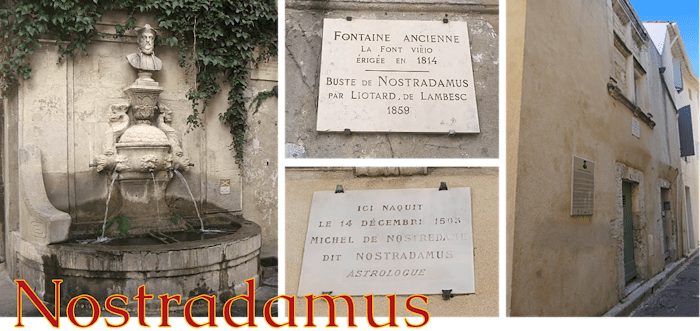
Born on December 14, 1503, Nostradamus grew up in the historic center of Saint-Rémy, in what is traditionally identified as his family home at 6 rue Hoche. The house is privately owned today, but a commemorative plaque recalls the birth of the famous physician and astrologer. His family background was deeply connected to medicine, scholarship, and humanist learning during the Renaissance.
A Humanist Education in Provence
Nostradamus spent his childhood in Saint-Rémy-de-Provence, surrounded by the landscapes of the Alpilles and the intellectual atmosphere of Renaissance Provence. According to local tradition, his grandfathers — especially Jean de Saint-Rémy — played an important role in his early education. He studied Latin, Greek, mathematics, astronomy, and herbal medicine at a young age.
The surrounding countryside also influenced him strongly. The surrounding countryside likely contributed to his interest in medicinal plants and herbal remedies. Long before becoming associated with prophecy, Nostradamus was primarily known as a physician and medical writer.
Physician, Astrologer, and Author
During the 16th century, Nostradamus traveled widely and gained recognition for treating victims of plague outbreaks in southern France. His medical reputation brought him considerable fame before his prophetic writings made him internationally known.
He later settled permanently in Salon-de-Provence, where he purchased a house in 1547. It was there that he wrote his famous Centuries, collections of poetic quatrains that became known as his prophecies. He remained in Salon until his death in 1566.
Today, his former residence in Salon-de-Provence survives as the Maison de Nostradamus, a museum dedicated to his life and work. The house has received the “Maison des Illustres” label and presents the historical context of Renaissance science, medicine, and astrology.
The Nostradamus Fountain
One of the principal memorials dedicated to Nostradamus in Saint-Rémy-de-Provence is the Nostradamus Fountain, located at the intersection of rue Nostradamus and rue Carnot in the historic center.
The fountain itself dates from the 19th century, during a period when many Provençal towns embellished their public spaces with commemorative fountains honoring local historical figures. The monument was completed in 1859, while the bronze bust of Nostradamus was added shortly afterward in the second half of the 19th century.
The bust was created by Belgian-born sculptor Jean-Amé Van der Buren. It portrays Nostradamus wearing Renaissance clothing and gazing slightly upward, reinforcing the scholarly and almost visionary image associated with him over the centuries.
Architecturally, the monument combines a carved stone fountain basin with a vertical pedestal supporting the bronze portrait. The ensemble reflects the taste for civic commemorative monuments common in southern France during the 19th century. Beyond its decorative role, the fountain became an important symbol of local pride, celebrating Saint-Rémy as the birthplace of one of France’s most famous historical figures.
Today, the fountain remains one of the most photographed heritage landmarks in the old town and is often included in walking routes dedicated to the history of Nostradamus and Renaissance Saint-Rémy.
Nostradamus in Saint-Rémy Today
Saint-Rémy-de-Provence continues to preserve the memory of its famous native son through several landmarks in the historic center. His name appears in street names, heritage itineraries, and cultural references throughout the town, reinforcing the connection between Saint-Rémy and Renaissance humanism.
Walking through the old centre — between the Porte du Trou and the Porte Saint-Paul — visitors can still experience much of the urban setting that would have been familiar during Nostradamus’s lifetime.
Understanding the “Prophecies”
Nostradamus became famous mainly because of his prophetic quatrains, written in deliberately obscure and symbolic language. Over the centuries, many readers have interpreted his texts as predictions of major historical events. Historians generally note, however, that the verses are often vague enough to be reinterpreted after events have already occurred, which largely explains their enduring reputation.
Despite the legends surrounding him, Nostradamus remains an important Renaissance scholar whose work reflected the intellectual world of his time — a period when medicine, astronomy, religion, and astrology were closely connected.
A Lasting Symbol of Saint-Rémy
Today, Nostradamus remains one of the defining historical figures of Saint-Rémy-de-Provence. Just as Vincent van Gogh is associated with the town’s artistic heritage, Nostradamus represents its Renaissance and intellectual legacy.
Saint-Rémy was not the city where he wrote his prophecies or spent his final years, but it was the place where his education, curiosity, and scientific interests first took shape — the true beginning of the life of one of the most famous figures in French history.

