
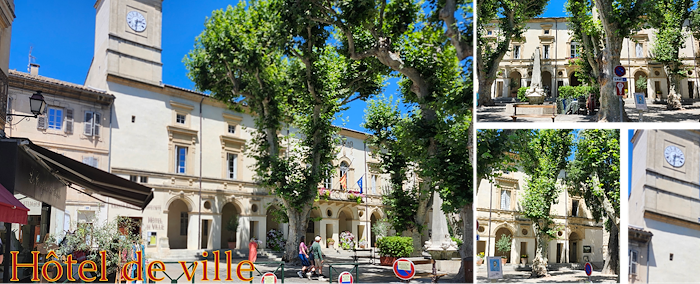
Located in the heart of the historic centre of Saint-Rémy-de-Provence, the Hôtel de Ville de Saint-Rémy-de-Provence overlooks Place Jules-Pellissier and has served for more than two centuries as the town’s main administrative and civic building. Through its history, architecture, and prominent location within the old village, it stands as one of the most emblematic public buildings in Saint-Rémy.
From convent to town hall
The history of the building began in the 17th century with the establishment of the Augustinian convent. At the time, the site included convent buildings, a cloister, and extensive gardens occupying what is now Place Jules-Pellissier.
During the French Revolution, Church properties were confiscated and nationalised. The convent was gradually abandoned and later transformed in the early 19th century to house municipal functions. Around 1818, the former convent buildings officially became the Town Hall of Saint-Rémy-de-Provence.
This transformation reflects a common evolution in many French towns after the Revolution, when former religious buildings were adapted to serve new civic and administrative institutions.
A sober and elegant Provençal architecture
The architecture of the Town Hall combines the heritage of the original convent with the civic renovations of the 19th century. The overall composition remains balanced and restrained, typical of Provençal public buildings of that period.
The main façade, finished in light-coloured render characteristic of Provence, is distinguished by its symmetrical organisation and the “The arcades on the ground floor may still reflect elements of the former convent structure. Like many historic buildings in the region, the structure features thick walls designed to protect interior spaces from the intense summer heat.
Above the main entrance, an elegant wrought-iron balcony extends from the first floor. As in many Provençal town halls, the balcony likely served for public announcements and official ceremonies.
The building’s most recognisable feature remains the small clock tower rising above the roofline. It is topped by an openwork wrought-iron campanile typical of Provence, housing the town’s civic bell. These lightweight structures were especially suited to the mistral, the region’s powerful wind, because they offered less resistance to strong gusts. Visible from several streets of the old town, the campanile still serves today as an important landmark in the urban landscape of Saint-Rémy.
The legacy of the former convent
Despite the administrative renovations carried out during the 19th century, several elements of the former Augustinian convent still survive within the overall structure of the building. Several elements of the overall structure still suggest the convent origins of the building.
Place Jules-Pellissier itself corresponds to the former convent gardens, which were transformed into a public square after the French Revolution.
The civic heart of Saint-Rémy
Since the 19th century, the Town Hall has played a central role in the public life of Saint-Rémy-de-Provence. It houses municipal services, council meetings, civil weddings, and numerous official ceremonies.
The square in front of the building regularly becomes the setting for local festivals, commemorations, and cultural events organised by the town. This constant activity contributes to making the Town Hall a true symbol of local civic life.
A building within a remarkable heritage setting
The Town Hall stands within one of the town’s richest historic and architectural districts. Just a few steps away are the Collégiale Saint-Martin, the Musée des Alpilles housed inside the Hôtel Mistral de Mondragon, and the Hôtel de Sade.
Facing the Town Hall, the Fountain of the Dolphins also contributes to the visual identity of the square and reinforces the harmonious character of this Provençal urban ensemble.
A symbol of historical continuity
More than a simple administrative building, the Town Hall reflects the evolution of Saint-Rémy-de-Provence across the centuries. A former convent transformed into the seat of municipal power, it embodies both the town’s religious memory, civic history, and the continuity of public life at the heart of the historic centre.

