
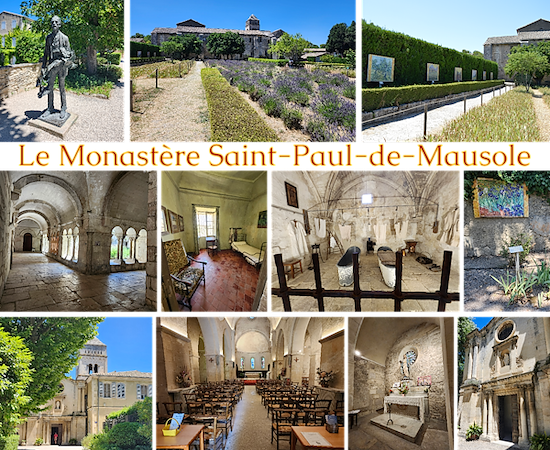
Located at the foot of the Alpilles, just a short walk from the Site archéologique de Glanum, Saint-Paul-de-Mausole Monastery is one of the most unusual places in Saint-Rémy-de-Provence. The site combines several dimensions rarely found together in one location: a former medieval abbey, a psychiatric institution still operating today, and a place deeply associated with Vincent van Gogh.
The site retains a religious presence and continues partly to function as a psychiatric care facility, giving the visit a calmer and more restrained atmosphere than a typical museum.
A Provençal Romanesque monastery
The site dates back to the 11th century and is considered a fine example of Provençal Romanesque architecture. The name “Mausole” comes from the nearby Mausoleum of the Julii, one of the Roman monuments of Glanum. Over the centuries, the monastic complex was enlarged, modified, and adapted to several different functions.
The general layout still reflects that of a medieval abbey organized around a central cloister. Vaulted galleries, rounded arches, simple columns, and walls built from local limestone are characteristic of southern French Romanesque architecture. Some sections also include later Gothic additions and modifications connected to the site’s later medical use.
The monastery church remains architecturally simple. Its square Lombard bell tower is one of the most recognizable features of the complex. Inside, the spaces are restrained and sober, with Romanesque vaults and very limited ornamentation, creating a very different atmosphere from the larger urban churches of Provence.
From monastery to psychiatric hospital
After the French Revolution, the monastery gradually changed function. In 1807, Doctor Mercurin purchased the site and established a private psychiatric hospital there. The institution has continued its medical activity ever since, although its organization has naturally evolved over time.
In the 19th century, psychiatric treatment relied mainly on rest, partial isolation, structured daily routines, and a calm environment considered beneficial to patients. Modern psychiatric medication did not yet exist. Patients lived under strict supervision, with carefully organized schedules, monitored walks, and sometimes hydrotherapy or bathing treatments.
This medical dimension remains visible during the visit. The public route includes several spaces connected to the former asylum: common rooms, reconstructed interiors, former treatment areas, and a reconstructed bath room illustrating treatments used during Van Gogh’s period. This gives the site a broader historical dimension than that of a simple religious monument.
Vincent van Gogh’s stay
The monastery is best known for having welcomed Vincent van Gogh from May 8, 1889, to May 16, 1890, following the crisis he experienced in Arles a few months earlier. Contrary to some common assumptions, Van Gogh voluntarily admitted himself to Saint-Paul-de-Mausole in order to receive treatment in a quieter environment.
Van Gogh was eventually allowed access to additional space for painting and storing his works. Although he remained hospitalized within the structured routines of the institution, these conditions were relatively favorable for a psychiatric patient of the period.
Van Gogh’s stay in Saint-Rémy is now considered one of the most productive periods of his career. In roughly one year, he created more than 140 paintings and over one hundred drawings. Several major works are directly connected to the landscapes surrounding the monastery, including The Starry Night, Irises, the cypress paintings, olive groves, and the landscapes of the Alpilles.
Van Gogh left Saint-Paul-de-Mausole on May 16, 1890, to move to Auvers-sur-Oise. He died slightly more than two months later, on July 29, 1890.
What visitors can see today
The public visit allows visitors to discover several aspects of the site. The route includes the Romanesque cloister, the church, the gardens, parts of the former asylum, and the reconstructed interpretation of Van Gogh’s room. Reproductions of paintings are installed throughout the grounds to compare the real landscapes with the artworks created there.
The gardens and planted walkways play an important role in the visit. Olive trees, cypresses, and flower beds directly recall many of the paintings Van Gogh created during his stay. A botanical and artistic trail helps visitors understand how the Provençal landscape influenced his work.
A living heritage site
Saint-Paul-de-Mausole occupies a rather unique position today. Part of the complex remains an active psychiatric institution welcoming patients, while another part functions as a cultural and historical site open to visitors. Public areas are clearly separated from medical spaces in order to preserve patient privacy and tranquility.
This coexistence between heritage, medical activity, and artistic memory strongly shapes the identity of the place. Unlike a fully museumized monument, Saint-Paul-de-Mausole remains a living site whose functions have continuously evolved since the Middle Ages.
A landscape later immortalized by Vincent van Gogh
The area surrounding the Mausoleum and the nearby site of Glanum also forms part of the famous Vincent van Gogh walking trail in Saint-Rémy-de-Provence. During his stay at the Monastère Saint-Paul-de-Mausole, Vincent van Gogh painted many of the surrounding landscapes of the Alpilles, olive groves, cypress trees, and countryside visible from this historic area. Reproductions of several of his paintings are installed along the walking route, allowing visitors to compare the present-day scenery with the artist’s works. This artistic dimension adds another layer of significance to the ancient Roman monuments, where archaeological heritage and cultural memory intersect within the same Provençal landscape.
Why visit Saint-Paul-de-Mausole
The site is especially interesting because it brings together several histories in one place: that of a Provençal Romanesque monastery, that of 19th-century psychiatry, and that of one of the world’s most famous artists. The visit offers both an opportunity to discover restrained medieval architecture and to better understand Van Gogh’s daily life during the most productive year of his career.
The peaceful gardens, the views of the Alpilles, and the immediate proximity of Glanum also make it easy to combine ancient heritage, religious history, and artistic culture during the same day in Saint-Rémy-de-Provence.

