
Avenue Vincent Van Gogh
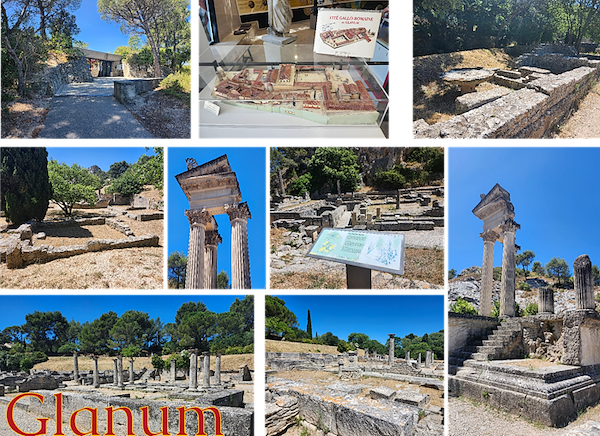
Located just south of Saint-Rémy-de-Provence, the archaeological site of Glanum preserves the remains of an ancient city founded by the Celto-Ligurians around the 6th century BC. The settlement later developed under Greek and Roman influence, becoming a prosperous Roman town before being abandoned during the 3rd century AD following invasions and regional instability. Its inhabitants moved farther north, to the site of present-day Saint-Rémy-de-Provence.
The name “Glanum” likely comes from the Celtic god Glanis, associated with the sacred spring around which the city developed. This natural spring, believed to have healing powers, explains why the site became an important religious center from the earliest period of its history.
A City Built Around a Sacred Spring
The history of Glanum began around this spring, which gradually became a major place of worship. Over time, the Greeks and later the Romans expanded the sanctuary surrounding it. Visitors can still see the spring basin, ritual structures, terraces, and several religious remains connected to the cult of water.
One of the site’s most unusual features is the dromos, a vaulted underground passage leading toward the sacred spring. This rare hydraulic structure highlights the importance of water in the religious and urban development of Glanum.
What You Can See on the Archaeological Site
One of Glanum’s greatest strengths is that it is not simply a collection of isolated ruins: the overall layout of the ancient city is still remarkably easy to understand. The walking route allows visitors to follow paved streets, drainage systems, terraces, and several clearly identifiable districts.
The residential quarter is one of the most impressive areas of the site. Here, visitors can see courtyard houses lined with columns, inspired by Hellenistic architecture. Some still preserve traces of mosaics, decorated floors, and domestic basins. The so-called “House of Sulla” is among the best-known examples.
The monumental center includes the forum, the city’s former public square surrounded by administrative and commercial buildings, as well as Roman baths with hot, warm, and cold rooms. Visitors can also see the civil basilica, used for legal and business matters, along with sanctuaries, porticoes, and temples connected to health and water cults.
The site also reveals the technical side of Roman urban planning through visible canals, masonry sewers, terraced streets, and remains of aqueduct systems adapted to the landscape of the Alpilles.
Les Antiques: Glanum’s Most Famous Monuments
At the entrance to the site stand the famous “Les Antiques,” visible even without entering the paid archaeological area. These two Roman monuments from the 1st century BC are among the best-preserved ancient monuments in France.
The triumphal arch likely marked the monumental entrance to the Roman city. Nearby, the Mausoleum of the Julii is especially remarkable for the quality of its sculpted decoration and its exceptional state of preservation. Even visitors who do not explore the full archaeological site often stop here for a quick visit.
An Accessible and Easy-to-Understand Visit
Glanum is often considered one of the easiest ancient sites to understand in Provence because the different areas of the city remain clearly identifiable. Audio guides and guided tours help explain daily life during the Roman period, including the operation of the baths, religious beliefs, urban planning, housing organization, and the role of influential families such as the Julii.
Most visitors spend between one and a half and two hours exploring the archaeological site, plus an additional 15 minutes to see Les Antiques. Near the entrance, there is also a small café and snack area where visitors can take a short break before or after the visit.
Archaeological collections in Saint-Rémy
Many of the archaeological discoveries uncovered at Glanum are now presented in the Hôtel de Sade in the center of Saint-Rémy-de-Provence. This historic townhouse, partially built over Roman remains, complements the visit to Glanum by displaying sculptures, fragments, and objects discovered during excavations of the ancient city.
Why Visit Glanum
Glanum is especially interesting because it reveals not only individual monuments, but the overall organization of a complete Gallo-Roman town. The site offers a clear understanding of how an ancient city functioned, from water management and religion to housing, public spaces, and urban infrastructure. The layering of Celto-Ligurian, Greek, and Roman influences also makes Glanum one of the most informative archaeological sites in Provence.

