
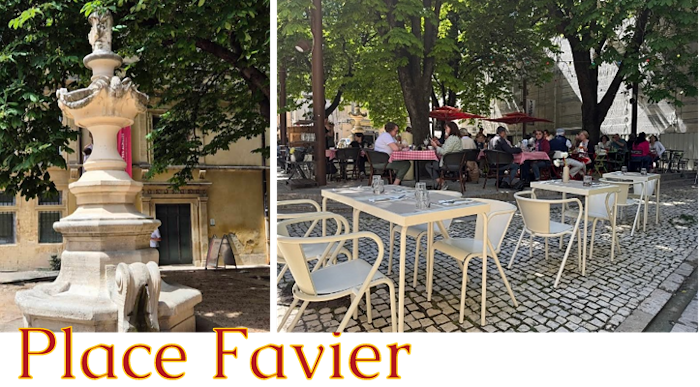
Favier Square — sometimes still referred to by its former Provençal name Place du Planet — is a small square in the historic centre of Saint-Rémy-de-Provence, nestled within the pedestrian area of Rue du Parage. Discreet yet representative of the atmosphere of the old town.
A heritage heart in the centre of the town
The square is dominated by the Hôtel Mistral de Mondragon, now home to the Musée des Alpilles. This Renaissance townhouse, with its remarkable inner courtyard and finely carved stone façades, is one of the most notable Renaissance residences in Saint-Rémy-de-Provence. It fully structures the space of the square and gives it a monumental character despite its modest size.
Around the square stand historic stone buildings and traditional residences that contribute to the distinctive character of Saint-Rémy’s old town. Just a few steps away, in Rue du Parage, stands the Hôtel de Sade, another major landmark of Saint-Rémy’s heritage located only a short walk from the square.
An intimate urban space
Like many historic Provençal squares, Place Favier owes much of its character to its human scale. Enclosed by closely spaced stone façades and connected to a network of narrow streets, the square functions as a small opening within the dense urban fabric of the old town. This relationship between confined streets and small public spaces is typical of medieval and early modern Provençal urban planning.
A lively Provençal atmosphere
Favier Square is a quiet pedestrian space shaded by trees, featuring a fountain and a few café and restaurant terraces. Together, these elements create a distinctly Provençal atmosphere that is both elegant and lively, particularly pleasant in summer.
It is a natural resting place when visiting the historic centre: both locals and visitors pass through, especially on market days when the surrounding streets become particularly animated.
A neighbourhood square through the centuries
Unlike the larger civic spaces of Saint-Rémy-de-Provence, such as Place de la République, Favier Square developed primarily as a local gathering place embedded within the residential fabric of the town. Its modest scale reflects the everyday life of the historic centre rather than major administrative or ceremonial functions.
A key reference point in the old town
Located within a dense network of medieval streets, Favier Square forms a pleasant crossroads in the historic centre. It is part of a compact heritage area reached after passing several narrow streets and notable sites of the old town, making it more of a structuring landmark than a simple starting point.
From the square, key locations in the old town — such as Rue Carnot, the town hall, and nearby historic townhouses — are all just a few steps away. The Hôtel de Sade is particularly close, illustrating the remarkable compactness of this historic district.
Who was Favier?
The origin of the name “Favier” is not widely documented today. The square nevertheless preserves this historic designation in the official toponymy of Saint-Rémy-de-Provence, while the older Provençal name Place du Planet remains familiar to many local residents. The older Provençal name Place du Planet remains familiar to many local residents. In Provençal usage, the term planet generally referred to a small open space or square within the urban fabric of a town.
A place between history and everyday life
Favier Square is therefore much more than a simple urban space: it brings together Renaissance architecture, museum heritage, neighbourhood life, and Provençal atmosphere. It is both discreet and central, perfectly reflecting the identity of Saint-Rémy-de-Provence — a dense, lively historic centre deeply rooted in its history.

