
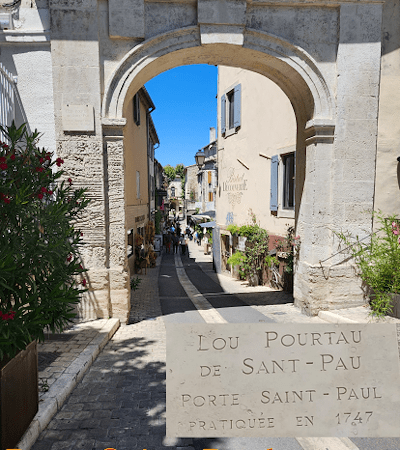
Porte Saint-Paul is one of the most emblematic historic entrances to the old centre of Saint-Rémy-de-Provence. Located on the southern side of the old village, it still marks the transition between the broad tree-lined boulevards outside the historic core and the narrower, more picturesque streets of the medieval centre.
Although it evokes the image of an ancient fortified medieval gate, the structure visible today actually corresponds to a later opening created in the town walls in 1747. It was designed to facilitate access between the town and the southern districts, particularly toward Saint-Paul de Mausole and the ancient Roman site of Glanum — hence its name.
An opening created for the expanding town
The first defensive walls of Saint-Rémy date back to the 14th century and originally served a clear military purpose. At that time, the southern side of the town formed an almost continuous wall, without a major gate at the present location of Saint Paul Gate.
Over the centuries, however, the town’s circulation needs evolved. Trade and travel toward Saint-Paul de Mausole, the roads leading to Glanum, and the development of the southern districts made a direct access increasingly necessary. An opening was therefore cut through the walls to create a more practical route to the south.
During the 18th century, as the old fortifications gradually lost their defensive function, the town transformed this practical passage into a true monumental urban gateway. The medieval walls slowly disappeared in favour of the circular boulevards that surround the old centre today, while Saint Paul Gate evolved into an urban landmark rather than a defensive work.
A simple yet symbolic architecture
Built from the pale stone typical of Provence, the gate features a large vaulted arch with a relatively restrained design. Its appearance is more elegant than defensive, reflecting the period in which it was created.
Unlike heavy medieval fortified gates, Saint Paul Gate resembles a small ceremonial urban arch integrated between the surrounding buildings. Nevertheless, it retains strong heritage value because it still represents the historic boundary between the fortified town and the outer districts.
The boulevards that now surround the historic centre largely follow the line of the former walls and defensive ditches.
A link between the town and its major heritage sites
Saint Paul Gate occupies a particularly strategic location in the history of Saint-Rémy. On the inside, it opens directly onto the old streets of the historic centre, especially toward Rue de la Commune and the commercial heart of the old village.
On the outside, the route extending from the gate naturally leads toward several of the town’s most important heritage sites: Saint-Paul de Mausole, the Van Gogh Walk, and Glanum.
This role as a connection point explains why the gate remains one of the most frequently used and photographed passages in the town today.
A gate still alive in the urban landscape
Although it no longer serves any defensive purpose, Saint Paul Gate remains deeply integrated into the daily life and urban identity of Saint-Rémy-de-Provence. It is an important landmark on walking tours and one of the most recognisable entrances to the historic centre.
Its charm lies precisely in the contrast between the bright outer boulevards and the more intimate atmosphere that appears immediately after passing beneath its stone arch.

