
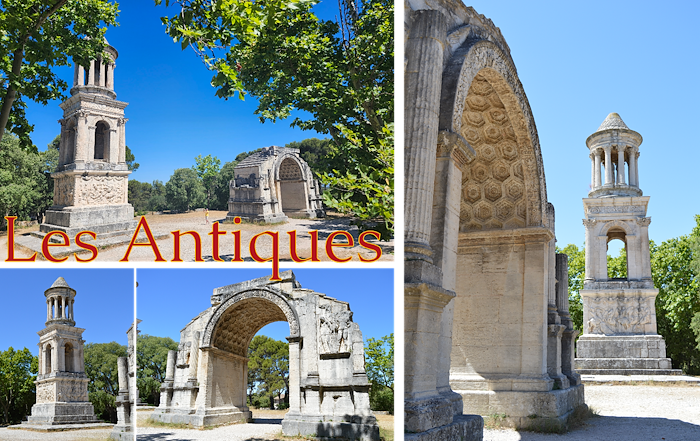
At the entrance of the Site archéologique de Glanum, at the foot of the Alpilles, stand two remarkably well-preserved Roman monuments known as “Les Antiques”: the Triumphal Arch and the Mausoleum of the Julii. Located by the roadside, they are today one of the most recognizable landmarks of Saint-Rémy-de-Provence. These monuments were included in France’s first official list of Historic Monuments in 1840.
The Triumphal Arch of Glanum
Dating from the early 1st century AD, probably during the reign of Emperor Augustus, the arch likely served as a monumental gateway to the Roman city of Glanum. Standing about 8.5 meters (almost 28ft) high, it still preserves finely carved bas-reliefs depicting military trophies, captive Gauls, and vegetal motifs associated with the Roman conquest of Gaul.
One of its most distinctive features is its current appearance. The arch has lost its original upper structure and roof, but protective coverings added during the Middle Ages and again in the 19th century give it a somewhat unusual silhouette. Despite its entirely Roman origin, it almost resembles a medieval structure.
The Mausoleum of the Julii
A few steps away stands the Mausoleum of the Julii, built between approximately 30 and 20 BC by a Romanized Gaulish family who had become Roman citizens after the conquest. It is considered one of the most remarkable and unusual this layered composition is highly unusual in Roman funerary architecture in France.
Its structure is highly distinctive: a rectangular base decorated with sculpted scenes depicting battles, processions, and heroic episodes; above it, a double-faced arch; and at the top, a small circular temple surrounded by columns and crowned with a pyramidal roof. This upper structure once housed statues of the individuals honored by the monument. This layered composition—base, arch, and circular temple—has virtually no known equivalent in Roman funerary architecture.
A landmark landscape and cultural setting
Today, Les Antiques are often photographed with the landscapes of the Alpilles in the background. Their isolated location among fields and trees creates a striking rural setting long appreciated by photographers, painters, and artists
The site also stood along the ancient route connected to the Via Domitia, the great Roman road linking Italy to Spain through southern Gaul. A secondary branch from this major axis led travelers directly toward Glanum, making the arch and mausoleum an impressive ceremonial gateway to the ancient city.
From this area, visitors can also follow the Van Gogh walking trail, which connects the Monastère Saint-Paul-de-Mausole and several landscapes painted by Vincent van Gogh during his stay in Saint-Rémy-de-Provence. This adds an additional artistic dimension to the visit of the Glanum area.

