
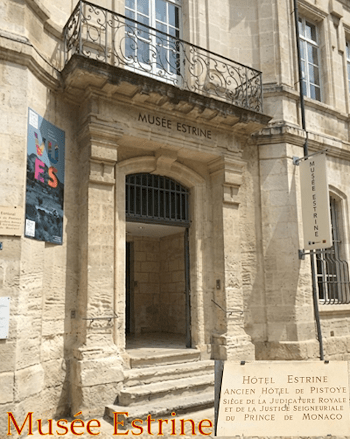
Hotel Estrine
8, Rue Estrine
I did not actually visit the museum itself, but the Hôtel Estrine still caught my attention through its understated elegance. Like many 18th-century townhouses in Saint-Rémy-de-Provence, the building reveals its charm through balance, proportion, and refined architecture rather than through ostentation. Having previously visited the Monastery of Saint-Paul-de-Mausole as well as the Van Gogh Museum in Amsterdam, I found it interesting to see how Saint-Rémy continues to preserve and reinterpret its connection with the painter’s world.
Today, the Hôtel Estrine is one of the main cultural sites in Saint-Rémy-de-Provence. This elegant 18th-century townhouse houses the Musée Estrine, dedicated to modern and contemporary art as well as the legacy of Vincent van Gogh in Provence. Located in the heart of the historic centre, the building combines architectural heritage with a contemporary artistic vocation.
An 18th-Century Provençal Townhouse
The building was constructed around 1748–1749 in a classical Provençal style inspired by the architecture of Aix-en-Provence during the Age of Enlightenment. Some sources attribute its design to the architect Charles François de Mondion.
Before becoming known as the Hôtel Estrine, the building was known as the Hôtel de Pistoye, a name still preserved on a commemorative plaque mounted on the façade. The Pistoye family belonged to the local elite and played an important role in the civic life of Saint-Rémy during the Ancien Régime. The residence reflected the social standing of its owners and was among the notable townhouses of the historic centre.
During part of its history, the building also served as the seat of both the royal judicature and the seigneurial court of the Prince of Monaco, whose jurisdiction extended over Saint-Rémy-de-Provence at the time. This judicial role is commemorated by the plaque that identifies the building as the former Hôtel de Pistoye and recalls its function as the “Siège de la Judicature Royale et de la Justice Seigneuriale du Prince de Monaco.”
Later, the property came into the possession of Louis Estrine, whose name would eventually become permanently associated with the building. Today, the Hôtel Estrine stands as a fine example of an 18th-century Provençal townhouse and one of the most distinguished historic residences in Saint-Rémy-de-Provence.
Elegant and Refined Architecture
The building is distinguished by the sobriety and harmony characteristic of Provençal townhouses of the period.
Among its notable architectural features:
- a symmetrical façade in warm blond stone,
- a formal entrance opening onto a paved inner courtyard,
- tall, evenly arranged windows,
- a monumental stone staircase with an elegant wrought-iron railing,
- stucco decorations and period mouldings,
- bright reception rooms now adapted as exhibition galleries.
The restoration undertaken at the end of the 20th century carefully preserved the spirit of the building while adapting it to its present-day museum function.
Restoration and Transformation into a Museum
After a long period of decline, the Hôtel Estrine was purchased by the municipality in 1985. A major restoration campaign followed and received the Grand Prix du Patrimoine Vivant from the Fondation de France in 1988 in recognition of the quality of the work carried out.
The building reopened as a cultural venue in 1989 under the initiative of the Présence Van Gogh association. Since 2007, it has officially operated under the name Musée Estrine and holds the prestigious Musée de France designation.
Vincent van Gogh and Saint-Rémy
One of the museum’s principal attractions is its Vincent van Gogh Interpretation Centre.
Although the museum does not possess original paintings by Van Gogh, it offers a multimedia and educational space dedicated to the crucial year the artist spent in Saint-Rémy-de-Provence between 1889 and 1890. During his stay at the Monastery of Saint-Paul-de-Mausole, Van Gogh created more than 150 paintings and numerous drawings inspired by the Alpilles landscapes and the Provençal countryside.
The centre includes:
- large-scale reproductions,
- documents and correspondence,
- multimedia presentations,
- analyses of works painted in Saint-Rémy,
- and contextual explanations of Van Gogh’s influence on modern and contemporary artists.
The museum is also part of the network recognized by the Van Gogh Europe Foundation.
Modern and Contemporary Art
Beyond Van Gogh, the Musée Estrine hosts an important artistic programme dedicated to 20th- and 21st-century art.
Its collections and exhibitions include:
- paintings,
- drawings,
- sculptures,
- graphic works,
- and works by modern and contemporary artists connected to Provence or Mediterranean landscapes.
The museum notably preserves an important collection devoted to the Cubist painter Albert Gleizes, who spent part of the final period of his life in Saint-Rémy-de-Provence.
Temporary exhibitions also regularly feature major artists such as Bernard Buffet, André Marchand, and Édouard Pignon.
A Peaceful Inner Courtyard
Typical of Provençal townhouses organized around protected interior spaces, the courtyard offers a calm retreat sheltered from the summer heat.
This space occasionally hosts:
- lectures,
- readings,
- concerts,
- artistic gatherings,
- and cultural events.
An Important Cultural Site in the Alpilles
The Hôtel Estrine illustrates particularly well how Saint-Rémy-de-Provence reuses its historic heritage by giving it a contemporary cultural role.
At once:
- an 18th-century townhouse,
- a museum of modern and contemporary art,
- a Van Gogh interpretation centre,
- and a venue for temporary exhibitions,
it plays an important role in the cultural and historical life of Saint-Rémy-de-Provence.
Through the successive identities of Hôtel de Pistoye, judicial seat of the Prince of Monaco, and finally Hôtel Estrine, the building reflects several centuries of local history while continuing to serve as a living centre of culture and artistic discovery in the heart of the old town.

