
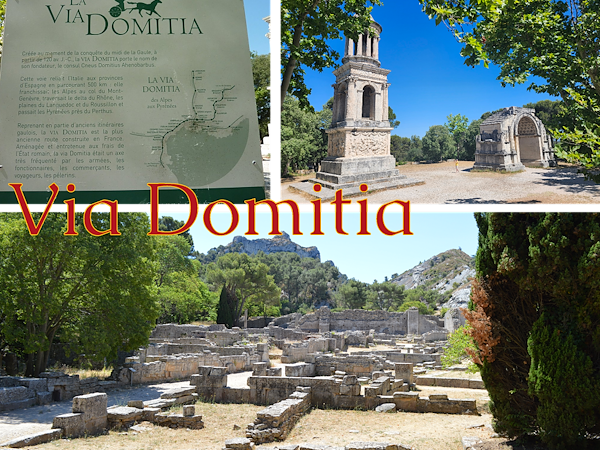
In Saint-Rémy-de-Provence, Roman history extends far beyond the archaeological site of Glanum or the famous Antiques monuments. It is literally embedded in the landscape itself. The Via Domitia, the first major Roman road built in Gaul, is one of the historical foundations of the region and still allows visitors today to understand the organization of the ancient territory through its paths, landscapes, and surviving remains around the Alpilles.
While walking through the countryside surrounding Saint-Rémy, it is sometimes difficult to imagine that one of the great strategic roads of the Roman Empire once passed here more than two thousand years ago. Yet behind the vineyards, olive groves, and peaceful rural paths lies one of the most important communication routes linking Rome to Spain.
Portions of the Via Domitia remained in use for centuries after the fall of the Roman Empire and influenced the layout of later medieval and modern roads throughout Provence.
The First Roman Road in Gaul
The Via Domitia was constructed beginning around 118 BC under the authority of the Roman consul Cnaeus Domitius Ahenobarbus. Its purpose was strategic: to connect Italy to the Iberian Peninsula by crossing Roman Gaul.
The road quickly became a vital route for:
• military movements,
• Mediterranean trade,
• imperial postal services,
• and cultural and administrative exchanges between Rome and its western provinces.
For centuries, local tradition associated certain sections of the route with the Via Aurelia. Historical research has since clarified that the road crossing the territory of Saint-Rémy-de-Provence was in fact the Via Domitia.
The true Via Aurelia ran farther south through Provence, while the Via Domitia passed north of the Alpilles before continuing toward the Rhône River near Tarascon and Beaucaire.
The Connection with Glanum
The main route of the Via Domitia did not pass directly through the ancient city of Glanum. Instead, an important secondary branch road connected the main route to the city.
Near the area known as La Croix d’Arles, an important branch road is believed to have connected the main route with Glanum.
This branch road passed:
• the so-called Mur de Marius, a large ancient stone retaining structure whose exact origin and function remain debated.,
• then reached the famous Antiques monuments,
• before entering the Gallo-Roman city of Glanum.
The Roman Triumphal Arch and the Mausoleum of the Julii thus marked the monumental entrance to the city for travelers arriving from the Via Domitia.
Roman Relay Stations and Ancient Travelers
Like all major Roman roads, the Via Domitia was lined with relay stations where travelers could rest or change horses.
Two main types of stations existed:
• mutationes, small relay posts used primarily for changing horses for official couriers;
• mansiones, larger stopping places offering lodging, food, and services for travelers.
These stations played a major role in:
• imperial administration,
• rapid communication across the Empire,
• military control,
• and the economic development of the surrounding territories.
They also contributed to the gradual Romanization of southern Gaul.
Visible Remains Today
Although much of the original Roman roadway is now buried or covered by later rural roads, several features still reveal the importance of the Via Domitia around Saint-Rémy-de-Provence.
Among the most notable remains and historical landmarks are:
• the Mur de Marius, an ancient dry-stone retaining structure,
• the Antiques monuments of Glanum/ the Roman Triumphal Arch, one of the oldest surviving examples in Gaul,
• and portions of the ancient alignment preserved within modern rural paths.
Together, these elements create a continuity between the modern landscape and the ancient Roman territory.
A Historical Walking Route Through the Alpilles
Today, the Via Domitia can be explored through a walking and cycling discovery trail.
Several walking and cycling routes, generally ranging from 9 to 10 kilometers, allow visitors to explore portions of the ancient corridor and its surrounding landscapes.:
• olive groves,
• vineyards,
• rural country paths,
• sections near the Canal des Alpilles,
• and areas connected with both Glanum and Vincent van Gogh.
The route is considered relatively easy and well suited for a half-day excursion.
Educational panels placed along the trail explain:
• Roman road construction techniques,
• the organization of the ancient territory,
• the role of relay stations,
• and the history of Glanum and the Alpilles region.
Between Ancient Heritage and Provençal Landscapes
The appeal of the Via Domitia in Saint-Rémy lies not only in its historical significance, but also in the unique way it allows visitors to experience the Provençal landscape.
Following this ancient Roman road means walking through scenery filled with:
• cypress trees and olive groves,
• vineyards,
• Mediterranean scrubland,
• and the limestone hills of the Alpilles.
In some areas, the route even passes landscapes later immortalized by Vincent van Gogh during his stay in Saint-Rémy.
A Road Connecting Different Eras
The Via Domitia perfectly illustrates how deeply ancient history remains embedded within the territory of Saint-Rémy-de-Provence.
Far more than a simple ancient road, it represents:
• one of the foundational axes of Roman Provence,
• an essential link with Glanum,
• a testimony to the organization of the Roman Empire,
• and today, a remarkable cultural and scenic route through the heart of the Alpilles.
Walking along its path ultimately feels like crossing several layers of history at once: Ancient Rome, medieval Provence, the landscapes of Van Gogh, and the living heritage of Saint-Rémy-de-Provence.

