
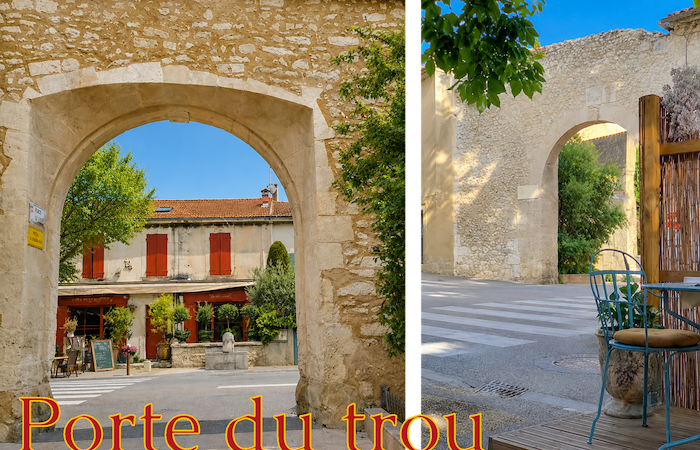
The Porte du Trou — known in Provençal as Lou Portail du Trauc — is one of the oldest historic gates in Saint-Rémy-de-Provence. Located on the northern side of the old town, it once served as one of the main entrances to the medieval fortified village. Together with the Porte Saint-Paul to the south, it remains one of the last visible reminders of the defensive walls that once surrounded the town.
Even today, the gate marks a clear transition between the modern tree-lined boulevards, laid out where the former moats once stood, and the narrower, more intimate streets of the historic center.
An Original Medieval Gate
Unlike the Porte Saint-Paul, which resulted from a later modification of the town walls during the early modern period, the Porte du Trou belongs to the original medieval fortifications. It dates back to the period when Saint-Rémy was enclosed by defensive walls, probably during the fourteenth century, in order to protect the population during times of insecurity and conflict in medieval Provence.
At that time, the gate played an important military and strategic role:
- it controlled the northern entrance to the town,
- monitored the roads coming from Avignon and northern Provence,
- and allowed passage across the defensive ditches surrounding the walls.
The medieval gate was likely much more imposing than it appears today and was probably associated with defensive features that have since disappeared, such as reinforced doors, a bridge, or closing mechanisms.
Why Is It Called “Porte du Trou”?
The name may seem unusual, but it does not refer to a damaged or broken section of the walls. The Provençal word trauc means “hole,” “opening,” or “passage.” Several local interpretations exist regarding the origin of the name.
One commonly accepted explanation connects the name to the topography of this part of the town::
- this part of the village lay at a lower elevation,
- rainwater and runoff flowing down from the Alpilles passed through this zone,
- and the gate helped channel both people and water out of the fortified town.
The name therefore most likely refers to a functional opening in the defensive system rather than to any structural defect.
Transformation in the Eighteenth Century
Like much of the fortification system of Saint-Rémy-de-Provence, the Porte du Trou was altered when the town walls lost their military purpose. Beginning in the eighteenth century, the defensive ditches were gradually filled in and replaced by the broad boulevards that now encircle the historic center.
The gate was subsequently transformed:
- its military appearance was softened,
- the light-colored stone arch was redesigned in a more elegant style,
- and the structure became integrated into the town’s more open urban layout.
The gate visible today therefore combines a medieval origin with major alterations from the early modern period.
An Iconic Entrance to Old Saint-Rémy
The Porte du Trou opens directly into the pedestrian streets and shopping lanes of the historic center. Its stone arch frames old façades, Provençal shutters, and lively little squares, making it one of the most photographed locations in Saint-Rémy-de-Provence.
The surrounding district is also connected to the cultural history of the town. Nearby is the Jardins district, traditionally associated with the childhood of Joseph Roumanille, the Provençal writer and co-founder of the Félibrige movement.
A Reminder of the Former Ramparts
Although most of the medieval walls have disappeared, the Porte du Trou retains strong heritage value. It recalls the former organization of Saint-Rémy-de-Provence:
- a town once enclosed by defensive walls,
- structured around a limited number of controlled entrances,
- and connected to the commercial and agricultural routes of Provence.
Modest in scale yet rich in historical significance, the Porte du Trou remains one of the most evocative surviving traces of medieval Saint-Rémy-de-Provence and one of the clearest reminders of the town’s former fortified character.

