
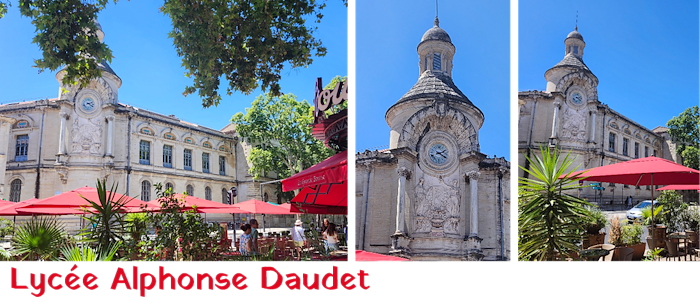
Facing the area around the Arènes de Nîmes, the Lycée Alphonse-Daudet (a historic high school) is far more than a school. It stands as one of Nîmes’ most distinctive buildings, where centuries of history meet through architecture, republican ideals, and rich decorative detail.
A site shaped over time
The site began as a hospice in the 16th century before gradually evolving into an educational institution.
In the early 19th century, architect Charles Durand designed a monumental neoclassical façade (from 1807), drawing inspiration from the Roman architectural heritage so present in Nîmes.
Later, between 1887 and 1889, architect Auguste Augière oversaw major expansions, including the addition of the now-iconic clock tower. The school was officially named after Alphonse Daudet in 1966, a 19th-century novelist and storyteller best known for his vivid portrayals of life in southern France, notably in Letters from My Windmill (Lettres de mon moulin).
A façade inspired by Antiquity
The main façade is defined by balance and clarity:
- large semicircular arches echoing nearby Roman monuments,
- strict symmetry and harmonious proportions,
- pale stone and restrained neoclassical lines.
Decoration is deliberately limited, reflecting a rational architectural approach typical of the early 19th century and its emphasis on order and civic purpose.
The clock tower: a focal point
The most eye-catching feature is the richly decorated clock tower at the corner of the building, clearly visible from the surrounding streets.
Beneath the clock, several symbolic elements stand out:
- two female figures representing Knowledge or the Arts,
- the letters “RF” (République Française), emblematic of the Third Republic,
- a large arch supported by imposing columns,
- the twelve signs of the zodiac carved into the decoration.
Near the top, sculpted heads evoke major ancient civilizations, including Greece, Rome, Egypt, and others—reflecting the broad intellectual references of the late 19th century.
Part of the sculptural decoration is attributed to Marcel Mérignargues, and the overall composition illustrates the era’s taste for combining classical heritage, science, and republican symbolism.
An eclectic architectural ensemble
Beyond its façade, the lycée forms a large and coherent complex combining several influences:
- neoclassical elements from the original structure,
- academic and eclectic additions from the late 19th century,
- the use of iron, brick, and ceramic details typical of the period.
Organized around multiple courtyards, with a structured and functional layout, the building was designed both as a place of learning and as a strong urban presence.
A place still in use
Today, the lycée remains one of the most respected schools in the region. It welcomes students from secondary level to preparatory classes, continuing a long educational tradition in the heart of Nîmes.
Not always open to visitors, it is still well worth pausing outside—if only to look up and take in its remarkable details.
In the footsteps of Alphonse Daudet
The writer’s presence can still be felt elsewhere in the city. Nearby, the Square de la Couronne features a fountain dedicated to him, offering a quieter tribute to his literary legacy.
A plaque also marks the location of his birthplace, reminding visitors that Nîmes was not only a source of inspiration, but the starting point of his life and work.

