
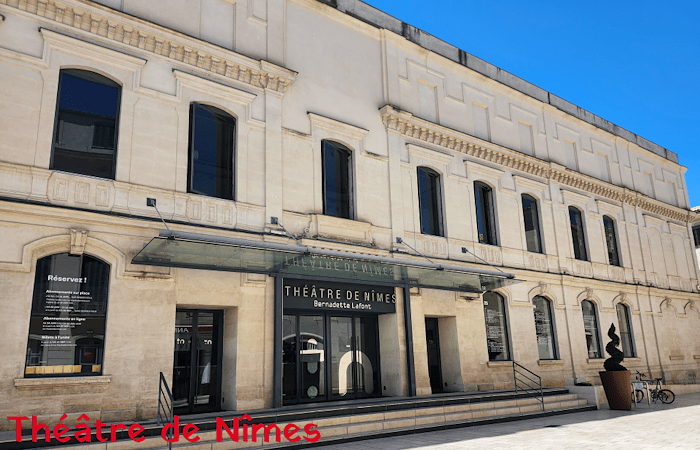
Set on Place de la Calade, just a short walk from the Carré d’Art, the Théâtre de Nîmes, now known as the Bernadette Lafont Theatre, represents a more contemporary side of the city—one turned toward live performance and artistic creation.
A history shaped by renewal
The theatre’s story begins with a major loss. In 1952, a fire destroyed the former municipal theatre located near the Maison Carrée, leaving Nîmes without a principal performance venue.
To maintain cultural life, the city turned to an existing 19th-century municipal hall originally designed for gatherings, celebrations, and public events. Intended as a temporary solution, it remained in use for several decades despite its technical limitations.
A decisive transformation came in 1988, when architect Jean-Michel Wilmotte redesigned the building under the initiative of Mayor Jean Bousquet. The former hall was converted into a modern theatre adapted to contemporary performance requirements.
Functional and contemporary architecture
From the outside, the building remains discreet, blending into its surroundings rather than competing with nearby historic landmarks. Its real strength lies inside, where the design emphasizes comfort, visibility, and acoustics.
The main auditorium, with around 800 seats, accommodates a wide range of performances—from theatre and dance to music—thanks to a flexible layout and a modular orchestra pit. The overall approach reflects late 20th-century public architecture, where functionality and audience experience take precedence.
A second venue, the Odéon—located nearby on rue Pierre Sémard—offers a more intimate setting. Originally a cinema built in the 1950s, it was converted into a small performance space in 1993. Now part of the Théâtre de Nîmes, it is particularly suited to contemporary and experimental works.
A place for creation and performance
Since 1990, the theatre has been managed by a cultural association and has established itself as an important stage within the regional and national performing arts network. Recognized as a scène d’intérêt national, it presents a diverse and demanding program including theatre, contemporary dance, music, and productions for younger audiences.
Artists such as Macha Makeïeff and the Deschiens troupe have contributed to shaping its identity, balancing artistic creation with public accessibility.
Honoring Bernadette Lafont
The theatre is named in tribute to Bernadette Lafont, a celebrated actress born in Nîmes and closely associated with the French New Wave. This naming highlights the strong link between the venue and the city’s cultural heritage.
A balance between heritage and modernity
The Theatre of Nîmes illustrates a thoughtful approach to urban reuse: transforming an existing building into a contemporary cultural space without erasing its past. Once a communal gathering place and now a professional stage, it continues to fulfill its original role—bringing people together.
In a city often defined by its ancient monuments, it offers a meaningful contrast: a space dedicated to present-day artistic expression, rooted in everyday life.

