
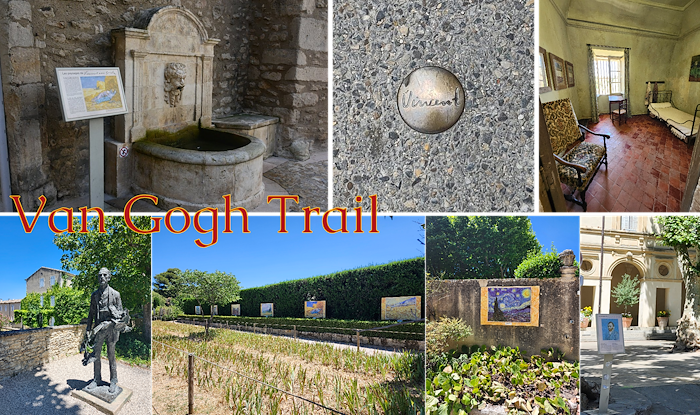
In Saint-Rémy-de-Provence, the Van Gogh Walk — also known as the Van Gogh Trail or The Landscapes of Vincent — invites visitors to follow in the footsteps of the famous Dutch painter Vincent van Gogh. This free walking route allows you to discover the authentic landscapes that inspired some of the artist’s most renowned works during his stay in Provence between May 1889 and May 1890.
The circuit connects the historic centre of Saint-Rémy-de-Provence with Saint-Paul de Mausole, the former asylum where Van Gogh chose to have himself admitted after the Arles crisis. This year spent in Saint-Rémy corresponds to one of the most intense and prolific periods of Vincent van Gogh’s career. Despite his psychological struggles, he produced more than 150 paintings and numerous drawings, including several works now considered major masterpieces in the history of art.
His personal journey
Although voluntarily admitted to Saint-Paul de Mausole, Vincent van Gogh was not completely isolated. When his condition allowed, he was permitted to walk beyond the grounds and paint in the surrounding countryside.
These movements between the monastery, olive groves, cypress-lined paths, and the Provençal village deeply nourished his inspiration. Fascinated by the light of the Alpilles, wheat fields, twisted trees, and the vibrant colours of Provence, Van Gogh transformed the landscapes he observed daily into highly expressive compositions.
Several of his most famous works — The Irises, The Starry Night, The Olive Trees, and Wheat Field with Cypresses — are directly rooted in the landscapes surrounding Saint-Paul de Mausole and the paths leading toward the village. Even today, the walk allows visitors to compare these paintings with the landscapes that inspired them, many of which remain strikingly recognisable.
A journey through Van Gogh’s landscapes
The walk follows a simple and accessible route of approximately 1.5 to 2 kilometres (about 1 mile) between the historic centre of Saint-Rémy-de-Provence and Saint-Paul de Mausole. Contrary to what is sometimes assumed, it is not a loop but a linear route: visitors should therefore plan for the same distance again if they return on foot along the same path. The main walk typically takes about one hour one way, although many visitors spend longer enjoying the scenery, reading the panels, or visiting related sites.
The route is marked by around twenty panels placed near the spots where Vincent van Gogh set up his easel. Each panel features a reproduction of a painting created in Saint-Rémy, accompanied by excerpts from letters written to his brother Theo van Gogh, along with explanations in French and English.
Small metal plaques on the ground marked “Vincent” also guide visitors along the entire path.
From the Provençal village to Saint-Paul Monastery
The walk usually begins near the Musée Estrine, which houses the Van Gogh Interpretation Centre. Located in an elegant 18th-century townhouse, the museum introduces Van Gogh’s life and work in Provence and serves as an excellent starting point before the walk.
The route then crosses the historic centre of Saint-Rémy-de-Provence, with its shaded boulevards, plane trees, and Provençal façades. As you follow Avenue Pasteur and then Avenue Edgar Leroy, the scenery gradually becomes more rural: wheat fields, olive groves, cypress trees, and views of the Alpilles hills immediately recall the painter’s compositions.
Arrival at Saint-Paul de Mausole is the most moving part of the journey. This is where Van Gogh lived in a small room overlooking the gardens and surrounding countryside. Today, visitors can explore the Romanesque cloister, the gardens, and a reconstruction of the painter’s room. Entry to the site is ticketed.
Because the route is not a loop, many visitors choose alternative ways to avoid walking the same path back. Some start directly with a visit to Saint-Paul de Mausole before walking back down into the village at a relaxed pace. Others park near the monastery and return by local taxi, bicycle, or seasonal tourist transport to avoid an additional hour of walking. It is also possible to extend the experience by exploring the historic centre, cafés, and small squares of Saint-Rémy instead of immediately retracing the route.
Iconic works along the route
Along the way, visitors encounter landscapes that inspired several of Van Gogh’s major masterpieces, including:
- The Starry Night
- The Irises
- Wheat Field with Cypresses
- The Olive Trees
- The Road Menders
- The Ravine of the Peiroulets
The experience is particularly striking because the landscapes of the Alpilles have changed relatively little since the late 19th century. Some cypress trees, paths, and olive groves still directly echo the painter’s compositions.
An artistic and immersive experience
More than just a walk, the Van Gogh Trail reveals the profound connection between Vincent van Gogh and the Provençal landscape. The contrasts of light, the movement of wind through cypress trees, and the vibrant colours of the fields explain why Saint-Rémy-de-Provence holds such an important place in his work.
This route is especially unique because Van Gogh is one of the few European painters whose creative locations can still be traced with such precision: he painted directly from nature, and his letters provide detailed descriptions of his surroundings, which remain largely recognisable today.
Morning light or late afternoon is particularly recommended to experience the trail in an atmosphere close to the one Van Gogh himself knew.
Practical information
- Free and open-access route year-round
- Average duration: about 30 minutes to one hour one way depending on stops
- Difficulty: very easy, flat and accessible path
- Leaflet and audio guide available at the Saint-Rémy-de-Provence Tourist Office
- “Van Gogh Natures” mobile app with maps, geolocation, and multimedia content
- The visit can easily be combined with Saint-Paul de Mausole and the Musée Estrine for a full half-day dedicated to the painter’s world

