
1379 – 1380 rue Sherbrooke Ouest
Montreal Museum of Fine Arts – A Cultural Landmark Evolving Through Time
It takes about 10 minutes to walk from the McGill University gates to the Montreal Museum of Fine Arts (MMFA), located on Sherbrooke Street West—a cultural corridor in the heart of the city.
As early as the mid-1800s, Montreal’s community demonstrated a strong appreciation for the arts. Though it was initially difficult to secure both funding and a permanent space to display artwork, interest was gradually built through mobile exhibitions. A turning point came in 1877, when philanthropist Benaiah Gibb donated his personal art collection to the Art Association of Montreal. This generous gift led to the construction of the Association’s first permanent gallery on Phillips Square, a building that no longer stands.
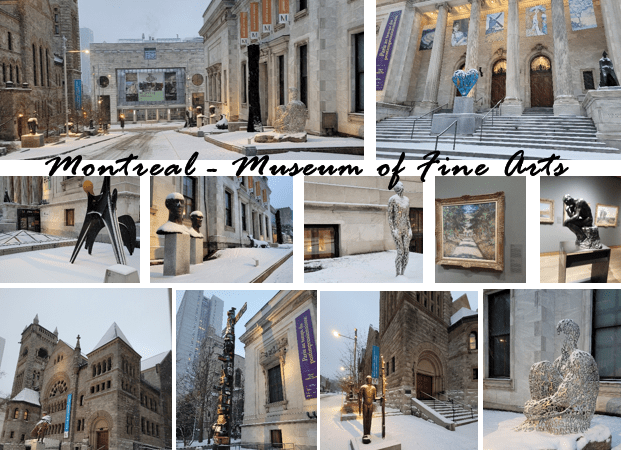
As the collection and public interest grew, the need for a larger space became clear. The current site at 1379 Sherbrooke Street West was selected, and in 1912, the first dedicated museum building opened—what is now known as the Michal and Renata Hornstein Pavilion, distinguished by its neoclassical façade and four grand columns.
The museum has since expanded significantly:
- In 1976, an annex named the Lilian and David M. Stewart Pavilion was added to house decorative arts and design.
- In 1991, the museum grew across the street with the opening of the Jean-Noël Desmarais Pavilion at 1380 Sherbrooke Street West, designed by Moshe Safdie. It is now the museum’s main entrance.
- In 2011, the Erskine and American United Church (built in 1893–1894) was integrated into the museum complex. Recognized as a National Historic Site in 1998, the church is an architectural gem, featuring original towers and stunning Tiffany stained glass windows. It now houses the Bourgie Concert Hall, an intimate performance space with seating for just over 460 guests. This section is known as the Claire and Marc Bourgie Pavilion.
- A modern addition on Bishop Street, opened in 2016, complements the museum’s more historic buildings and accommodates further galleries and activities.
Between the 1912 pavilion and the former church, the street has been transformed into a sculpture-lined promenade, seamlessly connecting the different wings of the museum.
The MMFA offers a rich mix of permanent and temporary exhibitions, showcasing a wide range of artistic expression—from ancient and classical works to modern, contemporary, and design-focused art. It features art from Quebec, Canada, and around the world, and also runs an innovative art therapy program.
A dedicated cinema entrance is tucked beneath the staircase of the 1912 building, expanding the museum’s cultural reach even further.
As with many great museums, the MMFA is difficult to fully experience in just one visit—but that only makes it more worth returning to.
For an overview of Montreal click here.
For all posts on Montreal click here.
 Simple Travel and Recreation
[…] has been internationally recognized for his work. While you have one example in the square, the Museum of Fine Arts in Montreal hosts some of his work. The colorful Palais des Congres (Convention Center) and the […]
LikeLike