
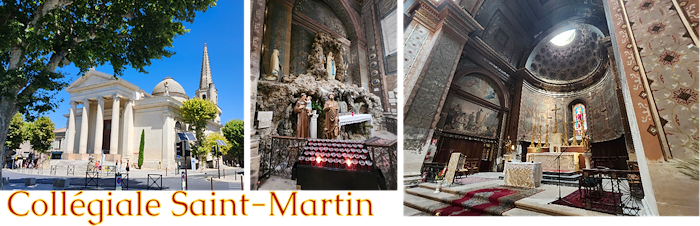
Located in the heart of Saint-Rémy-de-Provence, the Collegiate Church of Saint-Martin occupies an important place in the town’s religious heritage The building reflects several historical periods, combining medieval origins, a surviving Gothic bell tower, and a major 19th-century Neoclassical reconstruction. Its 14th-century Gothic bell tower, visible from much of the town, remains one of the principal landmarks of Saint-Rémy-de-Provence.
For many North American visitors, the term “collegiate church” may be unfamiliar. A collegiate church was historically administered by a college of canons — an organized community of clergy — but unlike a cathedral, it was not the seat of a bishop.
A history shaped by multiple reconstructions
A church has existed on this site since at least 1122. Originally, the site was occupied by a relatively modest Romanesque priory church. In 1331, Pope John XXII, then based in Avignon, elevated the priory to the status of collegiate church. This new status led to major enlargements, including the construction of a large Gothic choir and the soaring bell tower that still survives today.
A major event changed the building’s history in 1818, when part of the old church collapsed during construction work. The church was then almost entirely rebuilt between 1821 and 1825 by architect Michel-Robert Penchaud, who was responsible for several important projects in southern France.
The result is the church seen today: a bright and harmonious Neoclassical building that still preserves its impressive 14th-century Gothic bell tower.
Architecture unlike most Provençal medieval churches
Unlike many Romanesque churches in Provence, which are often darker and heavier in appearance, the Collegiate Church of Saint-Martin feels open, balanced, and full of light. The building is constructed from local limestone known as Saint-Rémy molasse.
The west façade is especially notable for its monumental Neoclassical portico with large columns, giving the church an appearance closer to certain 19th-century civic buildings than to a traditional medieval church.
Inside, the scale is surprising for a relatively small Provençal town:
- approximately 48 meters long;
- 27 meters wide at the transept;
- a nave rising to 16 meters;
- a central coffered dome reaching 26 meters in height.
The coffered dome, illuminated by a circular oculus above, is one of the most remarkable architectural elements of the church and has recently undergone restoration work. Its design reflects the strong influence of Neoclassical religious architecture that developed in France during the early 19th century.
The 14th-century Gothic bell tower remains the building’s most recognizable exterior feature. Rising more than 45 meters high, it creates an interesting contrast with the more restrained Neoclassical reconstruction surrounding it.
An interior combining medieval furnishings and 19th-century decoration
Although much of the church was rebuilt in the 19th century, several older elements survived. The high altar and baptismal font date from the early 14th century and still reflect the church’s medieval origins.
Most of the remaining furnishings were installed between 1825 and 1827 during the reconstruction period. The overall interior remains relatively restrained and harmonious in style.
In the choir, two surviving panels from an altarpiece dated to 1503 attract particular attention:
- a depiction of the Virgin of the Rosary;
- the figure of a standing bishop.
Wall paintings visible throughout the church were completed in 1874 by Jules Auric and contribute to the warm atmosphere of the interior.
The grand organ and musical tradition
The collegiate church is also known for its grand organ, considered one of the important instruments of the region. An organ was first installed in 1923, while the present instrument was extensively rebuilt in 1983 by organ builder Pascal Quoirin.
Its large polychrome organ case dominates the rear of the nave. The church regularly hosts concerts and the summer ORGANA festival, continuing an important musical tradition within the building.
An important restoration campaign
Since 2024, the church has been undergoing a major interior restoration campaign. The work includes:
- several sections of the nave;
- the crossing beneath the dome;
- the central dome itself;
- the oculus;
- 19th-century painted decoration.
Some of the restoration work uses modern techniques such as laser cleaning to preserve delicate surfaces without damaging the original decoration.
Why visit the Collegiate Church of Saint-Martin
The Collegiate Church of Saint-Martin is especially interesting because it reflects several periods of the history of Saint-Rémy-de-Provence within a single building: the medieval period, the influence of the Avignon papacy, the major 19th-century reconstruction, and the town’s continuing cultural life.
Its architecture is also unusual for Provence. The combination of a soaring medieval Gothic bell tower and a large, bright Neoclassical church creates an ensemble very different from the smaller Romanesque churches nearby. For North American visitors unfamiliar with the concept of a collegiate church, the site also offers a useful introduction to the historical organization of major European churches before the modern period.

