
Place de la République / Place d’Armes
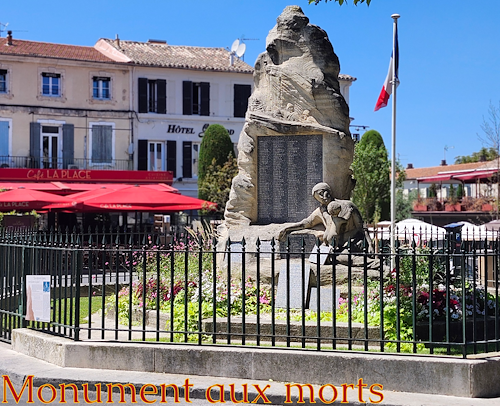
Located in the heart of Saint-Rémy-de-Provence, on the Place de la République and just a short walk from the Tourist Office and the Via Domitia walking route, the Monument aux Morts is one of the town’s most moving and distinctive memorials. Inaugurated on May 29, 1921, it stands apart from many French war memorials through its deeply human and pacifist approach, rooted as much in Provençal identity as in national remembrance.
A memorial unlike most others
While many First World War memorials in France focus on victorious soldiers and military heroism, the Saint-Rémy monument adopts a far more emotional and civilian perspective. Rather than glorifying war itself, it emphasizes mourning, memory, and the suffering endured by families left behind.
The monument was designed by Clara Saint René Taillandier, a Provençal artist and sculptor whose work combined symbolism, regional identity, and collective grief. She was an exceptional figure at a time when very few public war memorials were designed by women. The resulting composition remains one of the most distinctive and emotionally powerful war memorials in Provence.
A deeply Provençal monument
The memorial is strongly anchored in the cultural identity of Provence. On one side stands an Arlésienne — a traditional female figure symbolic of Provence and representing the town of Saint-Rémy itself.
She holds:
• a laurel wreath, symbolizing glory and remembrance,
• and an olive branch, representing peace.
Behind her appears an inscription in the Provençal language honoring the children of Saint-Rémy who died for France. The surrounding imagery also includes the silhouette of the Alpilles hills, immediately recognizable to local residents.
This local dimension gives the monument a unique character: it is not only a national memorial, but also a tribute deeply connected to the landscape, culture, and identity of Saint-Rémy-de-Provence.
Civilian grief rather than military triumph
One of the most remarkable aspects of the monument is its focus on civilian suffering. Beside the Arlésienne are:
• a grieving widow,
• and a child representing a generation marked by loss.
This choice of imagery was highly unusual in France after the First World War, where memorials more commonly depicted armed soldiers or patriotic combat scenes.
A discreet, weathered bas-relief depicting soldiers is also incorporated into the composition. Unlike many French war memorials, however, the emotional focus remains on the women, families, and children who carried the memory of the conflict long after the fighting ended.
Architecture and artistic composition
The monument is composed in a sober yet expressive style:
• sculpted stone figures with realistic drapery and facial expressions,
• a balanced frontal composition,
• and symbolic gestures conveying both grief and reconciliation.
The memorial is enclosed by an elegant wrought-iron fence, which is also protected as part of the historic monument designation.
Historical significance
Plans for the memorial were initiated before the end of the First World War, making it an unusually early expression of collective remembrance.
Over time, the monument also came to honor the victims of later conflicts:
• World War I (1914–1918),
• World War II (1939–1945),
• the Indochina War,
• and the Algerian War.
It remains an important place of remembrance for the town and is still used today during official commemorations such as May 8 and November 11 ceremonies.
A place of reflection in the heart of Saint-Rémy
Although modest in scale, the Monument aux Morts of Saint-Rémy-de-Provence possesses remarkable artistic and emotional depth. Through its Provençal symbolism, its civilian imagery, and its message of peace, it offers a powerful reminder that the memory of war is carried not only by soldiers, but also by the families and communities who endured its consequences. The monument and its wrought-iron enclosure are protected as Historic Monuments, recognizing both their artistic quality and their importance within the commemorative heritage of Provence.

