
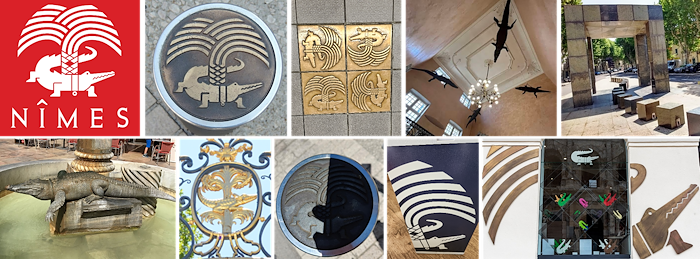
Before being a fountain or a sculpture, the crocodile is above all the symbol of Nîmes. It appears throughout the city, sometimes discreetly, sometimes prominently, but always with the same meaning rooted in its Roman past. Once you notice it, you start seeing it everywhere—on the ground, on buildings, on public elements, and even on official representations of the city.
Where you will see it across the city
The crocodile is not limited to one location. It is integrated into the urban landscape in many ways. In the historic center, small metal studs set into the paving—designed by Philippe Starck—mark paths through the city. You will also spot it in painted trompe-l’œil details, particularly along Rue de l’Aspic, as well as on façades and various elements of urban furniture.
It becomes a kind of visual thread, linking different parts of the city without ever needing to announce itself.
The official emblem, flag and signage
The crocodile and palm tree form the official coat of arms of Nîmes, adopted in the 16th century with the approval of Francis I of France. This emblem has remained in continuous use ever since.
Today, it appears on municipal signage, street name plaques, and flags displayed on public buildings. It is part of the city’s visual identity, both formal and everyday. The modern version, redesigned in 1986 by Philippe Starck, simplifies the design while preserving its historical meaning.
At the City Hall
Inside the Hôtel de Ville de Nîmes, the symbol takes on a more tangible form. Several preserved crocodiles are displayed, offering a surprising and almost unexpected encounter with the emblem. It is one of the few places where the symbol shifts from representation to physical presence, reinforcing its role in the city’s identity.
At the Avenue Carnot bus stop
Even in everyday infrastructure, the crocodile makes an appearance. At the bus stop on Avenue Carnot, the symbol is integrated into the design, turning a simple waiting area into a subtle reminder of the city’s identity. It is a small detail, easy to overlook, but very characteristic of how Nîmes incorporates its emblem into daily life.
The Roman origin of the symbol
The story begins in Roman times with a coin known as the “Crocodile of Nîmes,” technically a dupondius. It shows a chained crocodile attached to a palm branch, with the inscription NEMAVSVS, the ancient name of the city.
This image commemorates the victory of Augustus over Mark Antony and Cleopatra at the Battle of Actium. The crocodile represents defeated Egypt, while the palm symbolizes Roman victory. Over time, this image became more than political messaging—it became the defining symbol of the city.
A symbol tied to the rise of Nîmes
Following this victory, Nemausus was granted the status of a Roman colony, marking the beginning of a period of major development. The crocodile emblem can be seen as one of the earliest visual markers of this transformation, linking the city directly to imperial power.
The palm tree: an essential part of the image
The palm is not just decorative. Originally a Roman symbol of victory, it gradually evolved into a full palm tree in local imagery, always paired with the crocodile. Together, they form an inseparable composition that defines the identity of Nîmes.
The Crocodile Fountain on Place du Marché
At the center of Place du Marché, the Crocodile Fountain offers a contemporary interpretation of this ancient emblem. Created in the 1980s by Martial Raysse in collaboration with Vito Tongiani, it presents a monumental crocodile in a modern setting.
The sculpture reinterprets the original symbol: the palm appears severed, and the chain is broken, suggesting a form of liberation rather than domination. Despite its strong symbolism, the fountain remains relatively modest in scale and can be easy to miss amid the activity of the square.
A symbol that defines the city
In Nîmes, the crocodile is not a curiosity or a simple decorative motif. It reflects the city’s connection to Rome, the memory of imperial power, and the evolution of a symbol that began on a coin and became a lasting urban identity.
Today, whether on a flag, a street detail, or a public space, the crocodile continues to tell the same story—quietly, but everywhere.

