
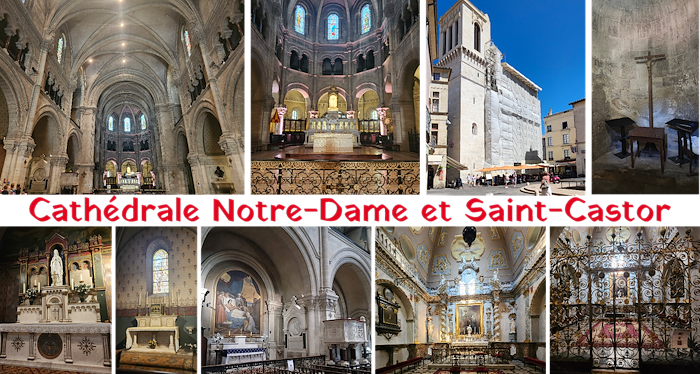
Located on Place aux Herbes in the historic center of Nîmes, Notre-Dame-et-Saint-Castor Cathedral is the city’s main Catholic church. Near the former episcopal quarter, it reflects several centuries of religious, architectural, and political history. Less monumental than Nîmes’ famous Roman landmarks, it nevertheless offers an important perspective on the city’s evolution from the Middle Ages to the modern era.
A cathedral rebuilt several times
A place of worship has existed here since the early Middle Ages. The first major Romanesque cathedral was consecrated in 1096 in the presence of Pope Urban II. Like many religious buildings in Nîmes, it suffered major destruction during the French Wars of Religion in the 16th century, particularly during the Michelade of Nîmes. A significant part of the medieval structure, including an important tower, disappeared during this period.
The cathedral was largely rebuilt during the 17th century in a relatively sober style. In the 19th century, architect Henri Antoine Révoil redesigned the interior in a Romano-Byzantine style that still defines much of the building’s atmosphere today.
A richer interior than the exterior suggests
From the outside, the cathedral appears rather austere, but the interior reveals a far more elaborate composition. The building is organized around a single nave that creates a clear visual perspective toward the choir. The 19th-century decorative program uses warm tones — ochres, reds, and golds — which bring unity to the space.
Arcades rhythmically structure the nave, while the side chapels create smaller and more intimate spaces. This relatively simple layout makes it easy to distinguish the different architectural periods without making the interior feel overcrowded.
The choir is especially notable for its richer decoration and for the burial places of several bishops of Nîmes beneath the high altar. The organ, parts of which date back to the 17th century, also reflects the cathedral’s long continuity as an active liturgical center.
Stained glass windows and side chapels
The cathedral contains a set of 19 stained glass windows depicting many religious figures associated with the history of Nîmes and its diocese, including Saint Castor, Saint Baudile, Saint Saturnin, Saint Louis, Blessed Urban V, and Saint Francis Regis. Most of these windows date from the 19th century and contribute greatly to the colorful atmosphere of the interior.
The side chapels also give the cathedral much of its character. Several contain paintings by the Nîmes artist Melchior Doze, whose work appears throughout the building.
On the south side of the nave are:
- the Chapel of Saint Joseph;
- the Chapel of Saint Firmin, featuring a painting of Firmin, bishop of Uzès;
- the Chapel of Saint Anne, where visitors can see a painting representing the Education of the Virgin as well as the sarcophagus of Cardinal François Joachim de Pierre de Bernis, an important 18th-century diplomat and political figure.
On the north side are:
- the Baptismal Chapel, containing a Baptism of Christ painted by Xavier Sigalon;
- the Chapel of Our Lady of Lourdes;
- the Chapel of Saint Louis;
- the Chapel of Saint Castor, whose stained glass window depicts Bishop Castor receiving Cassian’s Institutes.
The Chapel of the Immaculate Conception and the Chapel of the Rosary
Among the most remarkable spaces inside the cathedral is the chapel located behind the choir, now known as the Chapel of the Rosary. Built during the 17th century, it was originally dedicated to the Immaculate Conception and is considered the first chapel in France devoted to this dedication.
The chapel later became known as the Chapel of the Rosary after being restored by the Rosary confraternity. Both names therefore refer to the same chapel, reflecting different periods in its history rather than separate spaces within the cathedral.
This area immediately stands out because of its richer decoration compared to the rest of the cathedral. Deep blue tones, decorative ironwork, ornamental columns, and stucco decoration create a much more intimate and ornate atmosphere than the main nave. A painting by Melchior Doze further reinforces the devotional character of the chapel.
The chapel provides an interesting contrast with the relative sobriety of the cathedral as a whole while remaining fully consistent with the 19th-century decorative reworking of the interior.
Visible traces of Nîmes’ religious history
Despite its many transformations, several elements still reflect the site’s long history, including an early Christian sarcophagus, relics associated with Saint Castor, and several episcopal tombs. The cathedral also preserves the memory of the religious tensions that deeply affected Nîmes during the Wars of Religion.
Today, the building remains the seat of the Diocese of Nîmes, Uzès, and Alès. Listed as a historic monument and elevated to the rank of minor basilica, the cathedral continues to function as both an active religious site and an important historical and architectural landmark.

