
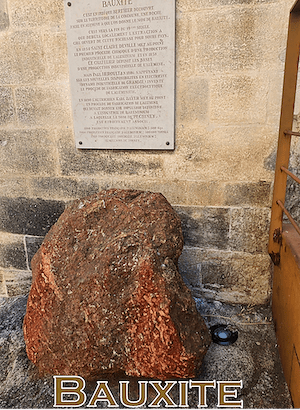
This is the first time I have devoted a text to a mineral rather than a museum—and for good reason. Not only does it bear a name directly linked to the town, but it was also discovered here. Bauxite, identified in the 19th century, is deeply intertwined with the history of Les Baux-de-Provence. A specimen can even be seen today just beside the tourist office.
Often overlooked by visitors, it nonetheless represents a true natural and historical resource—discreet yet essential—whose traces still shape the surrounding landscape. In its own way, it is an attraction in itself: less visible than monuments, yet equally revealing of the site’s identity.
Bauxite, the primary element used in the production of aluminum, was discovered in 1821 near Les Baux-de-Provence by the chemist and mining engineer Pierre Berthier. While initially searching for iron ore, he identified in the surrounding hills a reddish rock particularly rich in alumina.
This scientific discovery gave the mineral its name. In 1847, the geologist Armand Dufrénoy proposed the term “beauxite,” directly inspired by the name of the village. This was later simplified to “bauxite” in 1861 by the chemist Henri Sainte-Claire Deville, who also contributed to the industrial development of aluminum.
A Resource That Revived the Village Economy
From the mid-19th century onward, the exploitation of bauxite profoundly transformed the local economy. After several centuries of decline following the destruction of the castle in the 17th century, this mining activity brought renewed prosperity to the region.
Deposits located to the southeast of the village supplied the alumina and cement industries for more than a century. Between 1860 and 1993, over five million tonnes of rocks were extracted in the region.
Provence thus became one of the world’s leading bauxite-producing regions, accounting for a significant share of French production until the mid-20th century.
Mining Landscapes and Territorial Transformation
Bauxite was mainly extracted through open-pit mining, leaving behind the distinctive red-ochre cliffs still visible today. These operations significantly altered parts of the limestone relief of the Alpilles massif.
Even now, traces of this activity can be observed in the hills southeast of the village. Some former quarries, now abandoned, have gradually evolved into natural sites where water and vegetation have reclaimed the landscape.
The End of Mining Activity
Bauxite extraction in the Les Baux region gradually declined toward the end of the 20th century and came to a definitive halt in 1993. This was mainly due to the depletion of the most accessible deposits and increasing competition from countries with far larger reserves, such as Guinea and Australia.
Following the closure of the mines, the local economy progressively shifted toward heritage and cultural tourism, now highlighting the history and exceptional landscapes of the site.
A Geological Heritage to Explore
Today, several hiking trails allow visitors to explore landscapes shaped by this mining history. The Val d’Enfer, with its dramatic limestone formations, along with the former extraction sites of Mas Rouge, offer a striking insight into the geology of the Alpilles and the legacy of bauxite mining.
Although mining activity has disappeared, bauxite remains deeply connected to the identity of Les Baux-de-Provence. It is here that this mineral—now used worldwide to produce aluminum—was first discovered.
 Simple Travel and Recreation