
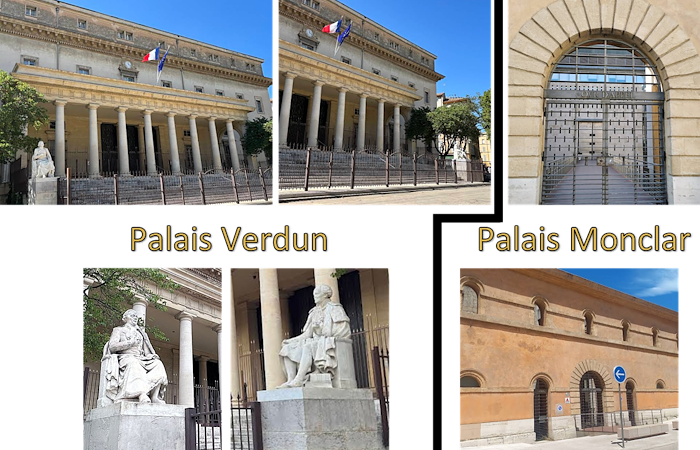
Place Verdun
The Palais de Justice d’Aix-en-Provence (Palais Verdun): A Civic Landmark
Overlooking the Place de Verdun in Aix-en-Provence, the Palais de Justice — often referred to as Palais Verdun — stands as one of the city’s most imposing civic monuments. Together with the adjacent Palais Monclar, it forms the judicial complex that houses the Court of Appeal of Aix-en-Provence, which exercises jurisdiction in civil, criminal, commercial, and social matters.
Origins and Urban Context
The site occupies the location of the former Comtal Palace, which had served since the Middle Ages as the seat of the Counts of Provence and later accommodated the Parliament of Provence and the Court of Accounts.
In 1787, the city commissioned the renowned architect Claude-Nicolas Ledoux to design a monumental new courthouse. His ambitious Enlightenment-era project required the demolition of more than 200 houses. Construction began but was halted by the French Revolution before completion.
The project was revived in 1822 by architect Michel-Robert Penchaud, who reinterpreted Ledoux’s concept within a more restrained Neoclassical framework. The building was completed in 1831, and judicial activity officially began there on 13 November 1832.
Architecture and Symbolism
The Palais de Justice exemplifies early 19th-century French Neoclassicism. Its monumental columned façade, symmetrical composition, and grand staircase express ideals of order, authority, and civic dignity consistent with post-Revolutionary institutional architecture.
The portico is flanked by marble statues sculpted by Joseph-Marius Ramus, representing two eminent jurists of Provence:
- Jean-Étienne-Marie Portalis
- Joseph Jérôme Siméon
Both played central roles in drafting the Napoleonic Code (Code civil des Français, 1804). Their statues affirm Aix’s major contribution to modern French legal history. In 2024, during the 220th anniversary commemorations of the Civil Code, their names were formally inscribed on the pedestals.
Interior: The Salle des Pas Perdus
Inside, the Salle des Pas Perdus (Hall of Lost Steps) forms the central circulation space. A glass roof installed in 1864 provides natural light, enhancing the monumental character of the interior. Fine ironwork, classical moldings, and the warm patina of Provençal limestone create a dignified yet accessible civic environment.
The Palais de Justice was listed as a Historic Monument in 1979.
The Palais Monclar: From Prison to Modern Courthouse
A Complementary Structure
Located on the same Place de Verdun, the Palais Monclar forms the second component of the judicial complex. Designed by Michel-Robert Penchaud and completed in 1832, it was originally constructed as a house of detention, replacing earlier penal facilities associated with the former Comtal Palace site.
From Medieval Seat of Power to 19th-Century Prison
After Ledoux’s aborted courthouse project, Penchaud developed a more functional structure adapted to penitentiary use. The building, roughly square in plan (approximately 50 meters per side), served as a prison for over a century.
The last public execution in Aix-en-Provence took place in front of the prison in 1934.
The facility was decommissioned in 1991. Subsequent archaeological excavations in the 1990s uncovered significant remains, including elements of a medieval hydraulic system and a 10th-century noria (waterwheel), attesting to the site’s long urban history.
Rehabilitation and Renaming
Following extensive renovation and adaptation, the building was integrated into the Court of Appeal complex and inaugurated in 1998. It was renamed in honor of Jean-François Ripert de Monclar, who served as Attorney General of the Parliament of Provence.
While the exterior retains the austere walls characteristic of its penitentiary origin, the interior was entirely reconfigured for judicial use. Limewashed walls, stucco finishes, restored ironwork, vaulted spaces, and circulation corridors integrate historical fabric with contemporary courtroom functions.
Today, the Palais Monclar principally accommodates criminal hearings, completing the judicial role of the adjacent Palais de Justice.
A Unified Judicial Ensemble
Together, the Palais de Justice (Palais Verdun) and the Palais Monclar represent successive layers of Aix-en-Provence’s institutional history — from medieval comtal authority to Enlightenment urban planning, from 19th-century penitentiary reform to a modern appellate court.
 Simple Travel and Recreation