
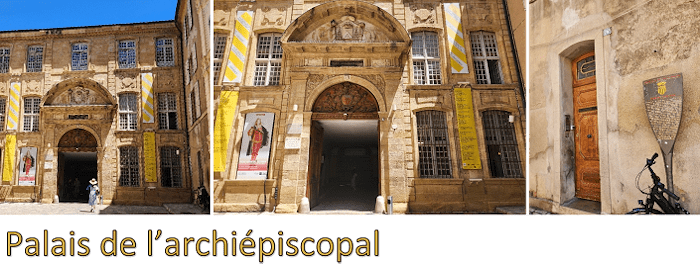
Palais archiépiscopal ou Palais de l’Archevêché / Musée des Tapisseries
28 place des Martyrs de la Résistance
The Archiepiscopal Palace: Spiritual and Artistic Power in Aix-en-Provence
Adjoining Saint-Sauveur Cathedral, the Archiepiscopal Palace of Aix-en-Provence is one of the most imposing and emblematic monuments in the city’s historic center.
Once the residence of the city’s archbishops, it bears witness to the central role of the Church in Provence from the Middle Ages through to the French Revolution, while today standing as a major cultural and musical venue.
A Site Steeped in History
The first palace was built in the 12th century, in the immediate vicinity of the cathedral. It housed the archbishops, who exercised both spiritual and political authority over the region.
Over time, the building was expanded and transformed—particularly during the 17th and 18th centuries—to form a vast architectural ensemble combining medieval, Renaissance, and classical influences.
The main body of the palace, arranged around a ceremonial courtyard, exemplifies Aix’s architectural refinement: sober façades of pale stone and state rooms fitted out between 1650 and 1780, all of which remain accessible to the public.
From Episcopal Residence to Cultural Landmark
After the French Revolution, the palace permanently lost its religious function and was successively assigned to various civic uses. It gradually evolved into a cultural venue, a role it continues to fulfill today.
The former state rooms of the archbishop’s residence now house the Aix-en-Provence Tapestry Museum, allowing visitors to explore these historic interiors while showcasing exceptional textile collections.
The Tapestry Museum: Textile Masterpieces and Performing Arts
The museum primarily displays 17th- and 18th-century tapestries, among the finest in France. Highlights include:
- Beauvais tapestries, notably The Grotesques (after Monnoyer and Bérain, 1689),
- the Don Quixote series (after Charles Natoire),
- and The Russian Games (Le Prince, 1769), works often commissioned by the archbishops of Aix to adorn their residence.
Another significant section is devoted to the lyric arts, directly connected to the International Festival of Lyric Art in Aix-en-Provence. The museum presents costumes, stage sets, and scale models created between 1948 and the 1990s by renowned artists such as Cassandre, Balthus, and André Masson, illustrating the dialogue between heritage and contemporary creation.
The Archbishop’s Courtyard: An Open-Air Stage
The palace’s inner courtyard, now fully open, has become an emblematic open-air theater. Each summer, it hosts performances of the International Festival of Lyric Art, offering an exceptional setting where historic architecture meets music and contemporary performance.
A Living Symbol of Aix’s Heritage
Today, the Archiepiscopal Palace embodies the successful transformation of a former seat of power into a vibrant cultural space. Through its historic salons, museum collections, and performance courtyard, it reflects the long history of Aix-en-Provence while remaining fully engaged in the city’s artistic life.

