
Pavillon de Vendôme
13 Rue de la Molle
An elegant retreat on the edge of the historic center
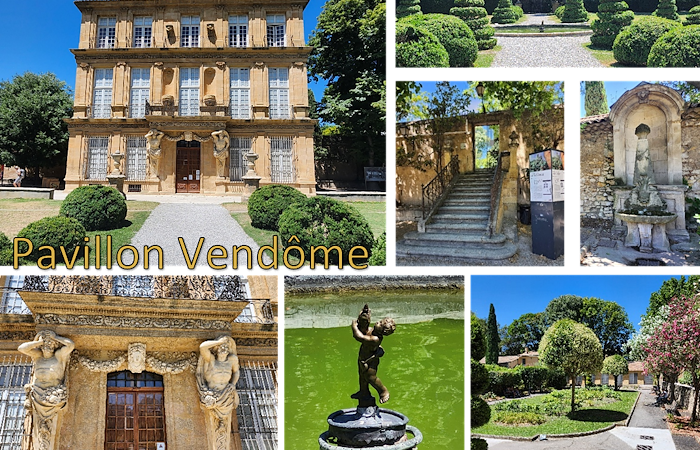
A short distance from the historic heart of Aix-en-Provence, the Pavillon de Vendôme is a refined example of 17th-century Provençal classical architecture. Originally conceived as a country retreat on the outskirts of the city walls, it reflects the taste of the aristocracy for discreet residences combining comfort, status, and architectural balance. Today, set within a walled garden, the pavilion houses a municipal art museum and remains a quiet landmark of Aix’s architectural heritage.
Origins and early history
The Pavillon de Vendôme was built between 1665 and 1667 at the request of Louis de Mercœur, Duke of Vendôme, grandson of King Henry IV and governor of Provence. Following the death of his wife, the duke became closely attached to Lucrèce de Forbin-Solliès, known as la Belle du Canet. Although often surrounded by romantic legend, the pavilion was above all a private residence intended for receptions and discreet stays, located outside the city walls and protected by enclosing crenellated walls.
Louis de Mercœur died in 1669, only two years after the completion of the building, and the property soon changed hands.
A classical architecture reshaped in the 18th century
Originally designed as a single-storey pavilion with open arcades at ground level allowing carriages to enter directly, the building underwent significant alterations in the 18th century. A second storey was added, the open arcades were closed, and the roof was replaced with traditional Provençal tiles.
The façade is organized according to a classical hierarchy of superimposed orders: Doric pilasters on the ground floor, Ionic on the first level, and composite on the upper storey. The entrance is framed by two baroque atlantes carved in stone, allegories of Dawn and Dusk, supporting a balcony with original wrought-iron railings. Decorative elements such as fruit garlands and sculpted masks reflect the restrained baroque language typical of Aix in this period.
Successive occupants and changing functions
After the death of the Duke of Vendôme, the pavilion experienced a succession of uses that mirror the social and cultural transformations of Aix-en-Provence. In the mid-18th century, it was acquired by the painter Jean-Baptiste van Loo, who installed his studio on the upper floor, turning the building into a place of artistic creation. It later became the property of Barthélemy-Louis Reboul, secretary of the Académie d’Aix.
During the French Revolution, Reboul emigrated to Italy with his family, and the pavilion was sold as national property in 1791–1792. In 1824, it was purchased by Abbé Jean-Joseph-Pierre Guigou, Bishop of Angoulême, who transferred it to the Sisters of the Sacred Heart. The building then served as a boarding school for young girls throughout the 19th century.
In 1906, the Swiss art collector Henri Dobler acquired the pavilion and undertook careful restoration work, seeking to reconstitute its historical character and furnishings. Thanks to his efforts, the façade and gardens were listed as historic monuments in 1914. After Dobler’s death in 1941, his collections were bequeathed to the City of Aix-en-Provence, and in 1954 the pavilion itself became municipal property, in accordance with his wish that it serve as a cultural institution. Since the late 20th century, the Pavillon de Vendôme has housed a museum and regularly hosts exhibitions of contemporary art and photography.
The gardens and outdoor setting
The pavilion is surrounded by enclosed gardens, originally designed in a formal French style and bordered by protective walls. While modest in scale, the gardens offer a calm and structured setting. Several discreet fountains are integrated into the landscape, some partially hidden near the walls beneath the trees, including a small fish fountain. At the center lies a circular basin featuring a small cherub, modest in size rather than monumental.
A secondary garden area, equipped with benches, provides a particularly quiet and restful space, appreciated by visitors seeking calm away from the busier streets of the city.
The museum today
Since 1954, the Pavillon de Vendôme has functioned as a municipal museum dedicated to the artistic and cultural history of Aix-en-Provence from the 17th century to the present day. Its collections include paintings, drawings, decorative arts, and furniture, with a strong emphasis on graphic arts. The museum also hosts temporary exhibitions that create a dialogue between historical heritage and contemporary creation.
Please note that the museum is closed on Tuesdays; during such days, the gardens may remain accessible while the interior spaces are not open to visitors.
A discreet landmark of Aix
Less monumental than other historic sites in Aix, the Pavillon de Vendôme offers a quieter, more intimate experience. Its layered history, restrained architecture, and enclosed gardens make it a place of transition between the aristocratic past of the city and its contemporary cultural life. It remains a subtle but meaningful witness to the evolution of Aix-en-Provence over more than three centuries.
 Simple Travel and Recreation