
Minato
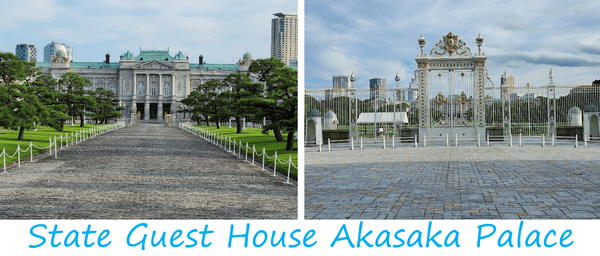
The State Guest House Akasaka was originally built (1899-1909) for the Imperial Family as one of the family’s royal residences for the Imperial Crown Prince (next in line), but is believed to have eventually been used by the Emperor himself.
The building is one of the few examples of neo-baroque construction in Japan and shows a clear influence of European architecture during the Meiji reign. The façade of this palace could easily be compared with other prestigious European sites such as the Hofburg Palace in Vienna or even Buckingham Palace in London, but on a smaller scale.
The site was relatively unaffected during the war but was transferred from the imperial family to the government. Over time, the place was transformed into offices for various administrative and public functions as well as the organizing committee for the 1964 Tokyo Olympic Games.
The palace needed to be revamped and redesigned, so it was decided that it would become a place for meetings, banquets and official lodging when visiting dignitaries visited the great Japanese city. There are three such palaces in the country, one in Kyoto and one in Osaka. The Akasaka Imperial Palace Guest House or State Guest House received its first guest in 1974, US President Gerald Ford.
It is, therefore, within the walls of the former Asakasa Palace that kings and queens, dignitaries, diplomats, prime ministers, presidents, and monarchs from different regions of the world are welcomed for important meetings and state dinners.
The building has been recognized as a national treasure since 2009.
A calendar on the official website lets you know when the palace is open. On Wednesday it is always closed. Obviously, we showed up on a Wednesday with the intention of walking peacefully around the site without visiting the interior but know that it is not an option. The gate, very pretty, by the way, is closed and, therefore, closed to exploring the gardens. In addition, the palace is several meters away, so it is not possible to admire the refinement of the architecture.
It was surprising to see that the square was completely inanimate and lifeless unlike other European palaces (Schönbrunn, Hofburg, Buckingham) which can be explored without visiting the palace itself. A slight disappointment considering that the fountain is at the back of the building and that the Japanese annex and the pond are not visible.
According to the photos on the official website, the furniture and reception rooms have a Western-style that is not found anywhere else in Japanese palaces.
The white gate is nicely decorated with gilding.
To get there, Yotsuya station is the closest and you will then be a 7-minute walk away.
For all my posts on Tokyo, click here.
 Simple Travel and Recreation