
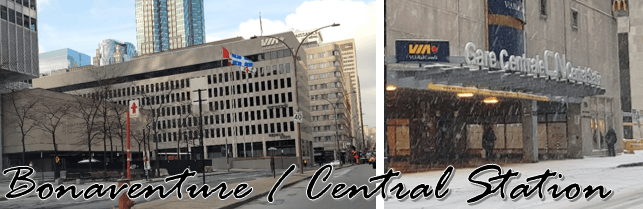
Montreal’s Central Station, located at 895 De la Gauchetière West, is the city’s main railway terminal and a major hub for regional and intercity transport. Completed in 1943, it was designed by architect John Schofield in a style combining Art Deco and International architecture. The station is built on two levels, with the main hall on the ground floor and the platforms in the basement, adapting to the urban landscape. Its grand hall, adorned with murals and bas-reliefs by Charles Comfort, depicts life, leisure, and industry in Canada, with inscriptions of the national anthem “O Canada” in both French and English.
A Strategic and Cultural Hub
Central Station is not just a major transport hub but also a dynamic cultural center. Since the 1980s, it has been expanded with the addition of the Halles de la Gare, a shopping mall featuring about fifty shops and restaurants, which contribute to the station’s liveliness every day. The station’s architecture, including its high ceilings and elegant geometric lines, makes it an iconic example of Art Deco architecture in Montreal. It also hosts temporary public art installations, enhancing its role as a cultural destination.
Connectivity and Accessibility
The station is directly connected to the Bonaventure Metro station, making it easy to travel around the city. It also links to Montreal’s vast underground network (RÉSO), which allows travelers to access numerous downtown offices, shopping centers, hotels, and event spaces without stepping outside. This underground network makes the station even more of a central hub in the city.
Central Station serves suburban trains from Exo, intercity trains from VIA Rail to major Canadian cities, and the Adirondack train from Amtrak to New York, connecting Montreal to destinations across Quebec, Canada, and the United States. It is also a key stop on the Réseau Express Métropolitain (REM), which extends its lines to Brossard, the airport, and other areas of the city.
A Key Piece of Montreal’s Heritage
Designated a heritage railway station by the Canadian government in 2010, Central Station embodies Montreal’s transport history and the city’s evolution in the 20th century. Its historical and functional role has been reinforced by its strategic location in the heart of downtown. Before its construction, Montreal’s railway network was fragmented, with several stations like Bonaventure and Windsor that were not well connected, making travel more complicated. The Windsor Station was ultimately abandoned in favor of Central Station due to its less strategic location and technical constraints.
More Than Just a Station
Today, Central Station is more than just a place to catch a train; it is an entry point to Montreal’s vibrant downtown. It is surrounded by major landmarks like Place Bonaventure, the impressive Marie-Reine-du-Monde Cathedral, inspired by St. Peter’s Basilica in Rome , the iconic 1000 De La Gauchetière, and the which contribute to the vitality of the neighborhood.
The station also offers an enjoyable experience for visitors who want to relax in one of its cafes, observing the diversity of travelers passing through. The station can get busy during lunchtime when many workers stop by for a break.
A Tragic Event: The 1984 Bombing
One dark chapter in the history of Central Station occurred on September 3, 1984, when a bomb exploded inside the station, killing three young French tourists and injuring several dozen others. The perpetrator, a former American military man suffering from mental health issues, was sentenced to life in prison but died during his trial. The explosion caused significant material damage and deeply shocked Montreal’s population. Despite the severity of the event, no commemorative plaque has been installed at the site, and the bombing remains largely forgotten by the public today.
The Bonaventure Station and Its Legacy
Before the construction of Central Station, the Bonaventure Station was one of Montreal’s main railway terminals. However, due to its less strategic location and connectivity issues with other stations, it was demolished in 1952 after suffering several fires. Today, the Bonaventure Metro station and a nearby square bear the name of the former station, preserving its historical legacy.
Conclusion
Montreal’s Central Station is more than just a transit point. It is a place where history, architecture, and culture converge, symbolizing the city’s growth and the evolution of its transport network. Its strategic location in the heart of downtown, its central role in urban and intercity transport, and its architectural heritage make it a must-see for both Montrealers and visitors to the city.
For an overview of Montreal click here.
For all posts on Montreal click here.
 Simple Travel and Recreation