
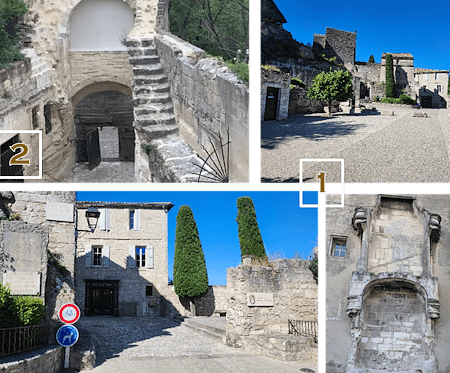
Access to the village of Les Baux-de-Provence is not defined by a single gate, but by a sequence of spaces that gradually lead visitors from the modern world into the medieval town. This layout, largely redesigned in the 20th century and refined up to the present day, reflects the rise in tourism—particularly after the village was listed among the “Most Beautiful Villages of France” and with the opening of the Carrières de Lumières.
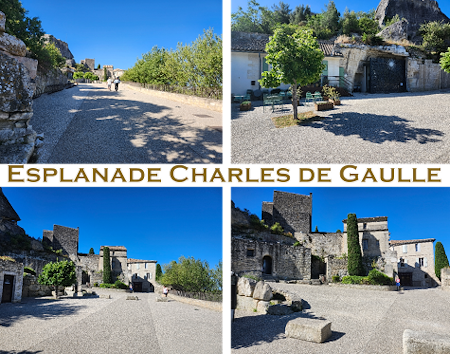
- The Charles-de-Gaulle esplanade
Coming from the parking areas, visitors first cross the Charles-de-Gaulle esplanade, a large open and functional space. This reception platform, not of medieval origin, structures the arrival and offers a first encounter with the striking landscape of the Alpilles.
It pays tribute to Charles de Gaulle, a major figure in French history. As in many French towns, his name is given to a prominent public space, highlighting the national significance of Les Baux as a heritage site, even without a direct historical link to the village.
This area also provides practical amenities for visitors, including public restrooms and a simple food area, reinforcing its role as a welcoming space. The ground, still largely asphalted, clearly reflects its modern function.
From the esplanade, visitors can already take in the limestone cliffs, the first historic façades, and the ruins clinging to the rock, offering a preview of the village’s unique atmosphere.
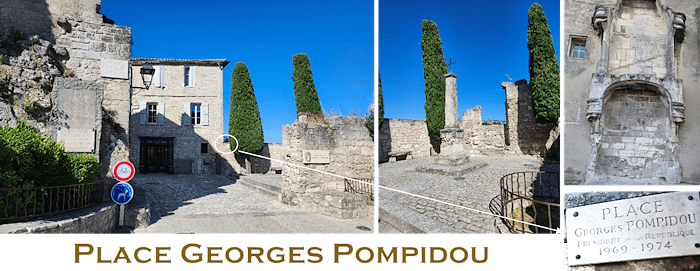
Place Georges Pompidou and the Porte Mage square: a contemporary gateway
Following the esplanade, Place Georges Pompidou forms a transitional space. Rather than a monumental square, it acts as a symbolic threshold between the access road and the medieval streets.
It is named after Georges Pompidou, whose commitment to culture and heritage contributed to the promotion of major historic sites in France. His name here reflects the role of the state in preserving places such as Les Baux.
Immediately adjacent, a small open area often referred to as the Porte Mage square—sometimes difficult to distinguish from the place itself—forms a continuous ensemble. Located near the tourist office, it serves as a gathering point and transition area for visitors.
It is also here that a clear transformation occurs: the ground gradually shifts from asphalt to paving stones and natural stone, signaling the entrance into the medieval fabric.
A threshold marked by visual landmarks
This small square is defined by several characteristic elements: low stone walls, a slight open space at the foot of the ascent, and a metal cross set on a base. This cross, likely installed in the 20th century, follows the Provençal tradition of wayside crosses. It symbolically marks the entrance to the village and serves as a clear visual landmark for visitors.
Nearby, the first shops and the tourist office reinforce the welcoming and functional role of this space.
Rue Porte Mage: the historic entrance
From this point, the ascent continues along Rue de la Porte Mage, leading to the former fortified gate of the village. This route corresponds to the original medieval entrance, once controlled and defended.
It was through this passage that travelers, merchants, and supply convoys entered, making it a strategic point between the outside world and the village interior.
A landscape of ruins and memory
From the square and along the initial ascent, visitors can see striking remains: collapsed walls, openings, and isolated stone fireplaces, visible just above the small square. These ruins, typical of Les Baux, reflect former houses built against the rock and their gradual abandonment, particularly from the 18th century onward.
They are an essential part of the site’s identity, where architecture and natural landscape are closely intertwined.
A passage between two worlds
The entrance to Les Baux-de-Provence is therefore not a single gateway, but a carefully staged progression—from the modern esplanade to the transitional square, and then to the paved ascent leading to the medieval gate. This journey prepares visitors to cross a meaningful threshold—both physical and symbolic—between the contemporary village and the historic hilltop town.
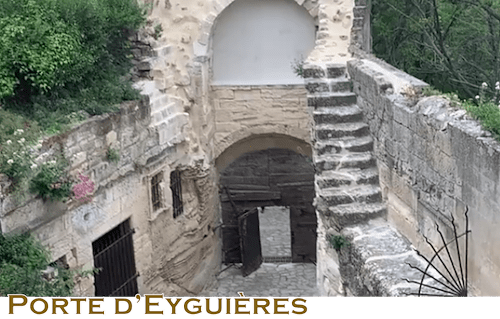
2. The Porte d’Eyguières
The Porte d’Eyguières, also known as the “Water Gate,” is one of the most emblematic elements of the former ramparts of Les Baux-de-Provence. Until 1866, it was the village’s only access point, making it a site rich in history and essential to understanding the defensive organization of the settlement.
It is reached via the cobbled Calade path, which descends toward the Vallon de la Fontaine—once vital to the village’s water supply. Water entered the village through this gate, which explains its evocative nickname.
The gate underwent several phases of reconstruction over the centuries. It was notably rebuilt by the Constable Anne de Montmorency, and later restored in the 18th century by the Prince of Monaco, after the barony of Les Baux was granted in 1642 to the House of Grimaldi. The Grimaldi coat of arms can still be seen above the arch, carved into a cartouche adorned with Baroque motifs.
The Porte d’Eyguières retains several features of its defensive system, including a corbelled wall-walk (chemin de ronde), arrow slits, and the remains of a former guardhouse to the north, now occupied by the Musée des Santons.
After the village lost its military function in 1632, access routes evolved. In the mid-19th century, a new entrance—the Porte Mage—was created by opening a passage through the ramparts to facilitate access. From that point on, the Porte d’Eyguières ceased to be the main entrance, though it retained its strong heritage value.
Now listed and remarkably well preserved, it remains one of the most significant vestiges of the fortifications of Les Baux-de-Provence and an iconic passage into the heart of the medieval village.
For an overview of all sites to visit in Les Baux-de-Provence click here.
 Simple Travel and Recreation