
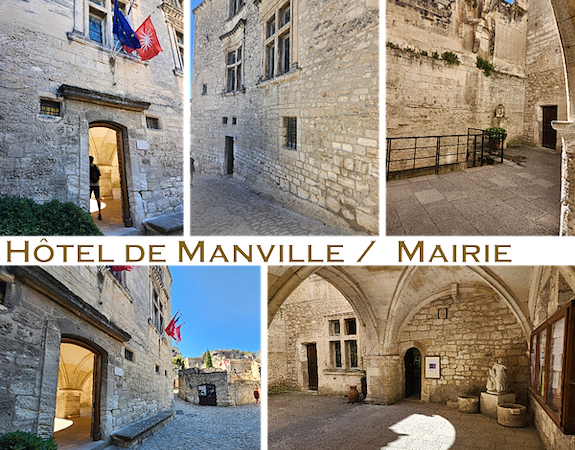
Located in the historic center of Les Baux-de-Provence, the Hôtel de Manville stands as a notable example of Renaissance civic architecture in Provence. Built in 1571, this elegant townhouse is distinguished by the balance of its composition and the fine quality of its pale limestone masonry, which contrasts with the more rugged medieval fabric of the surrounding village.
A noble residence shaped by its time
The building was commissioned by Claude II de Manville, a local nobleman and military figure. His career unfolded in a period marked by political and religious tensions, particularly during the French Wars of Religion. While the Manville family was part of the regional elite, their precise religious affiliation remains uncertain. The residence nonetheless reflects the presence of a cultivated and influential class in Les Baux during the 16th century. Over time, the property changed ownership before eventually becoming municipal property.
A façade of restrained elegance
The façade of the Hôtel de Manville exemplifies the measured refinement characteristic of the Provençal Renaissance. Carefully ordered and harmonious, it integrates classical inspiration with local building traditions:
- Regularly arranged bays punctuated by simply framed rectangular windows
- A projecting cornice marking the transition to the attic level
- A monumental carriage entrance with a full semicircular arch, forming the central focal point
- A heraldic cartouche above the portal bearing the arms of the Manville family.
Rising over three storeys topped with attic space, the building blends seamlessly into the medieval streetscape while expressing a sober Renaissance aesthetic influenced by Italian models. The façade can be admired from Rue du Trémolé, near the Church of Saint Vincent.
A remarkable inner courtyard
Beyond the entrance lies a rectangular courtyard bordered by arcades with full semicircular arches resting on Tuscan columns. This luminous and balanced space is characteristic of Renaissance townhouses in southern France. At its far end, a double-revolution exterior staircase leads to the upper floors, enhancing the architectural coherence of the ensemble. Some interior elements, including plasterwork and fireplaces, have been restored, although public access remains limited.
From private residence to town hall
Today, the Hôtel de Manville houses the town hall (mairie) of Les Baux-de-Provence. Protected as a historic monument, it remains a powerful symbol of the village’s heritage and its administrative importance during the early modern period. Its remarkable state of preservation makes it one of the most emblematic civic buildings in the village.
Town hall or city hall?
In French, both mairie and hôtel de ville designate a municipal administrative building:
- Hôtel de ville is generally used in larger cities and often refers to a purpose-built monumental structure
- Mairie is the more common term in villages and small towns
In this case, the building functions as the mairie, installed within a former Renaissance residence rather than a purpose-built city hall.
Visitor information
The inner courtyard may be accessible during town hall opening hours. The façade can be viewed freely from Rue du Trémolé, in close proximity to the Church of Saint Vincent.
 Simple Travel and Recreation