
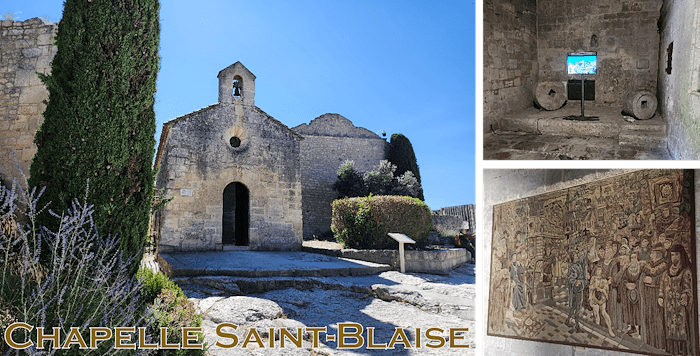
A chapel connected to the textile trades
Located at the edge of the village near the entrance to the former castle site, at 28 rue du Trencat, Saint-Blaise Chapel is one of the smallest yet oldest religious buildings in Les Baux-de-Provence. Built in the 12th century, it was erected by the guild of weavers and wool carders, who placed it under the protection of their patron saint, Blaise of Sebaste.
Saint Blaise, a 4th-century bishop and martyr originally from Armenia, was traditionally invoked by textile workers and craftsmen involved in the wool trade. The chapel thus served both as a place of devotion and as a gathering place for artisans whose work played an important role in the local economy.
During the early modern period, between the 17th and 18th centuries, the building became the official seat of the confraternity of weavers and wool carders in the village.
A remarkably simple Romanesque design
Saint-Blaise Chapel is notable for its modest size and the austerity typical of small Romanesque religious buildings in medieval Provence.
The structure follows a very simple rectangular plan composed of a single nave built of carefully cut stone blocks laid in large courses. The roof is covered with traditional Roman tiles, characteristic of regional architecture.
The western façade perfectly reflects this simplicity. It features a semicircular arched doorway framed by large stone. Above the entrance is a circular oculus, designed in a funnel-like shape that allows natural light to enter the interior while symbolically representing divine light in Christian tradition.
At the top of the gable stands a small bell, restored in the twentieth century. The bell currently in use was ceremonially blessed by Claude Pompidou, reflecting the continued interest in preserving this modest yet meaningful monument.
A site occupied since ancient times
Archaeological investigations around the chapel have revealed that the site had been occupied long before the Romanesque building was constructed. Excavations uncovered prehistoric flints, ancient coins, and fragments of pottery from several periods, including protohistoric, Roman, and medieval times.
These discoveries indicate that this rocky promontory overlooking the Alpilles valley had long been an area of human activity, highlighting the strategic and economic importance of the Baux site throughout history.
Heritage protection
Saint-Blaise Chapel is officially protected as a historic monument. It was listed as a Historic Monument on June 9, 1904, recognizing its architectural and historical significance within the heritage of Les Baux-de-Provence.
This designation ensures the preservation of the building and its surroundings within the remarkable landscape of the Alpilles.
A peaceful stop along the visitor route
Today the chapel has been desacralized and is no longer used for religious services. Instead, it serves a cultural function and hosts a permanent projection introducing visitors to the history and landscapes of Provence.
With its pale stone silhouette surrounded by olive trees and its understated architectural form, Saint-Blaise Chapel offers a quiet and contemplative pause along the visitor route connecting the historic village to the ruins of the castle above.
Though modest in scale, the chapel preserves the memory of the artisan confraternities that once shaped the social and economic life of Les Baux-de-Provence during the Middle Ages and the early modern period.
 Simple Travel and Recreation