
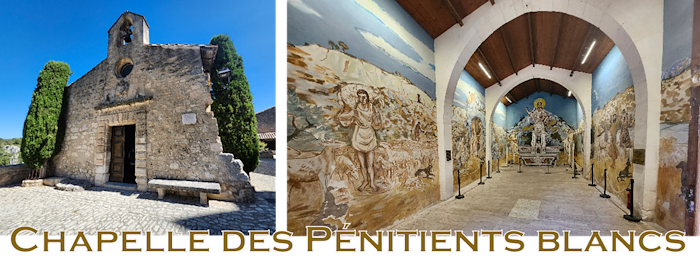
Located near the parish church on Place Saint-Vincent, at the edge of the cliff overlooking the Vallon de la Fontaine, the Chapel of the White Penitents is one of the discreet yet meaningful landmarks of the historic village of Les Baux-de-Provence.
Built in the mid-17th century, the chapel belonged to the Confraternity of the White Penitents, a lay religious association devoted to acts of charity, spiritual devotion, and assistance to the poor.
As in many towns across Provence, such confraternities played an important role in community life. Their members helped care for the sick, assisted the needy, organized religious ceremonies, and participated in public processions that marked the rhythm of village life.
The penitential confraternities of Provence
Penitent confraternities were widespread in southern France from the late Middle Ages through the early modern period. These associations brought together laypeople who committed themselves to a life of prayer, humility, and charitable service.
The White Penitents of Les Baux were recognizable by their traditional attire: a white robe and hood symbolizing humility and equality among members. Beyond their spiritual practices, these confraternities also played a role in funeral rites and acts of social solidarity, reflecting their deep integration into local society.
Architecture and monumental entrance
The chapel displays a sober architectural style typical of confraternity buildings. Its façade is dominated by a monumental entrance framed with rusticated stone blocks, a decorative technique that emphasizes the strength and dignity of the structure.
Above the doorway is a carved bas-relief depicting two kneeling penitents in prayer. Accompanying the sculpture is a Latin inscription, partly erased over time:
“In nomine Jesu omne genus flectatur”
(“At the name of Jesus every knee shall bend.”)
This motto expresses the humility and devotion that characterized the spiritual mission of the penitents.
Ruin, restoration, and remembrance
With the gradual decline of religious confraternities during the nineteenth century, the chapel fell into ruin. It was restored in 1937 by the Maintenance des Confréries de Pénitents de Langue d’Oc, an organization dedicated to preserving the heritage and traditions of the historic penitential confraternities of southern France.
In 1939, the association solemnly installed a statue of Estelle of Saintes, intended to watch over the memory of the former penitents of Les Baux. Saint Estelle is also the patron saint of the Provençal literary movement known as the Félibrige, founded to preserve and promote the Provençal language and culture. The statue has since disappeared.
The frescoes of Yves Brayer
Inside the chapel, visitors encounter a striking artistic intervention dating from the twentieth century. In 1974, the painter Yves Brayer, who maintained strong ties to Provence and the Alpilles region, created a series of frescoes depicting the Shepherds’ Christmas.
These pastoral scenes illustrate traditional Provençal Nativity imagery: shepherds in regional costume, flocks moving across the landscape, and the warm light of the Mediterranean countryside. Brayer’s expressive style creates a remarkable dialogue between the historic architecture of the chapel and modern artistic interpretation.
An inscription of memory
On the chapel floor, a Provençal inscription was engraved by the Maintenance of the Penitents’ Confraternities to commemorate the former members of the brotherhood.
Its translation reads:
“Under the protection of Saint Estelle, virgin and martyr, Penitents of Les Baux, rest in peace! The living will pray for your souls as long as the ancestral traditions of the Latin race endure.”
The inscription reflects the chapel’s role as a place of remembrance as well as devotion.
A discreet yet evocative monument
Today, the Chapel of the White Penitents stands as a modest monument within the historic village. Its austere façade, the traces of confraternity life, and the unexpected presence of modern frescoes together illustrate the evolving heritage of Les Baux-de-Provence.
 Simple Travel and Recreation