
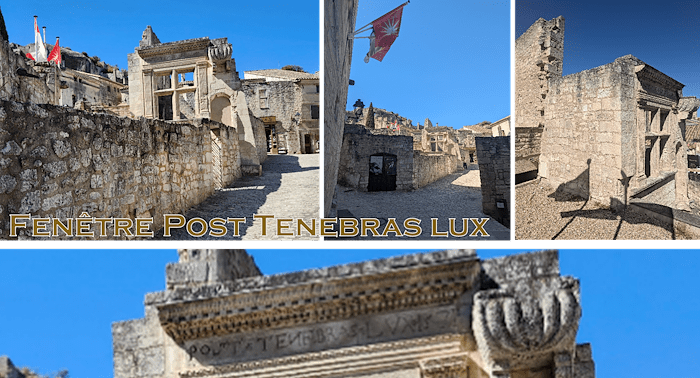
Facing the Hôtel de Manville, along the main street of Les Baux-de-Provence, stands a discreet yet remarkable remnant: a Renaissance window bearing the inscription “Post Tenebras Lux 1571”, meaning “After darkness, light 1571.” Listed as a historic monument since 1905, this mullioned window is the last surviving element of the former Brisson-Peyre residence.
A symbol of Protestant presence
This Calvinist motto is a valuable testament to the Protestant presence in Les Baux during the 16th century. At that time, the village—under the influence of local families such as the Manvilles—experienced a degree of religious tolerance. In the absence of official churches, Protestants often gathered in private homes: the Brisson-Peyre residence likely served as a domestic oratory for worship and assemblies.
An inscription rich in history
The date 1571 does not mark the construction of the building, but rather the addition of the window itself, in the style of the late Renaissance. Already visible long before the 17th-century siege, the inscription clearly expressed the religious identity of the site and reflects an active Reformed presence in the village.
A gradual disappearance, not a destruction
Contrary to a common belief, the Brisson-Peyre residence was not destroyed during the events of 1633. The actions carried out under Richelieu primarily targeted the Château des Baux-de-Provence and its fortifications, not civilian buildings.
In the aftermath, the village entered a period of decline and depopulation. Without maintenance, the residence gradually deteriorated over the centuries until it almost completely disappeared. Only the window, firmly set within a solid wall, survived. The date 1571 also confirms that this feature had already existed for over sixty years at the time of the siege. It is therefore a typical case of gradual abandonment, common in medieval villages, rather than a targeted destruction.
A rare and evocative remnant
Modest in appearance, this window is nonetheless a rare clue to the spread of Reformation ideas in Provence. Combining Renaissance architecture with religious memory, the “Post Tenebras Lux” window recalls a singular moment in the history of Les Baux, where faith, power, and local identity were closely intertwined.
 Simple Travel and Recreation