
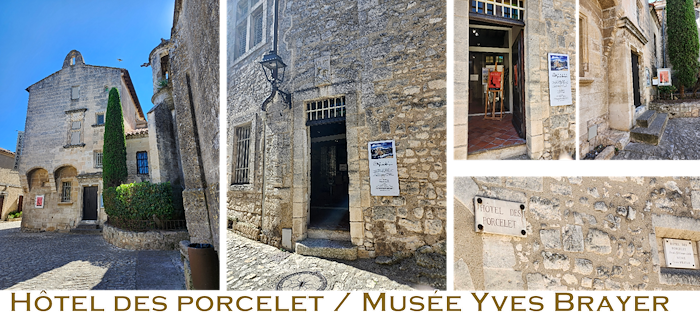
Located just behind Saint-Vincent Church, on Place François de Hérain in Les Baux-de-Provence, the Hôtel des Porcelet is one of the most remarkable historic residences in the village. This 16th-century townhouse was built by the Porcelet (or Porcellets) family, a powerful noble lineage from Arles whose influence extended across Provence during the Renaissance.
Listed as a historic monument since 1904, the building reflects the refinement of aristocratic residential architecture of its time. Its understated façade is punctuated by mullioned windows, while the ground floor preserves elegant vaulted rooms combining late Gothic structure with early Renaissance elements.
Remarkable Interior Architecture
Inside, the hôtel reveals a richness that often surprises visitors. The vaulted ground-floor rooms feature 17th-century painted decorations, including allegories of the Four Seasons and the Cardinal Virtues. A monumental fireplace is adorned with a mythological scene depicting the Fall of Phaethon.
Upstairs, French-style wooden ceilings and brighter rooms illustrate the evolution of the building over time. Together, these elements form a coherent architectural ensemble where multiple historical layers remain visible.
From Historic Residence to Museum
After serving various functions—including a school until the 20th century—the Hôtel des Porcelet was restored and, in 1991, became home to the museum dedicated to Yves Brayer.
This transformation reflects a meaningful connection between a historic setting and an artist deeply inspired by the landscapes and culture of Provence.
Yves Brayer and Mediterranean Light
Born in 1907, Yves Brayer was a major figure in 20th-century French figurative painting. Winner of the Prix de Rome in 1930, he pursued an international career while remaining committed to a style rooted in observation and reality.
From 1945 onward, he spent part of each year in Provence, particularly near Les Baux, where he found enduring inspiration. The landscapes of the Alpilles, the Camargue, its white horses, black bulls, and vast horizons became central themes in his work.
A painter, engraver, illustrator, and stage designer, he also created more than 200 sets and costumes for opera and theatre, notably for the Paris Opera and the Comédie-Française.
A Collection Rooted in the Region
The museum presents a major retrospective of Brayer’s work across several floors. Around one hundred pieces—paintings, watercolors, drawings, and prints—trace the evolution of his artistic career.
Visitors can discover:
- landscapes of Les Baux and Provence,
- scenes from the Camargue, featuring horses, bulls, and gardians,
- works inspired by his travels in Spain, Italy, Morocco, and Mexico.
The display highlights his distinctive palette, dominated by warm ochres, reds, and Mediterranean blues.
A Living Cultural Space
Beyond its permanent collection, the museum regularly hosts temporary exhibitions, creating a dialogue between Brayer’s work and that of other modern and contemporary artists.
This ongoing exchange reinforces the spirit of the site: a living space where architectural heritage and artistic creation meet.
A Living Legacy in Les Baux
The Hôtel des Porcelet – Yves Brayer Museum perfectly embodies the meeting of history and art. Once a Renaissance aristocratic residence, now a cultural venue, it offers visitors a layered experience combining architecture, artistic expression, and a deep sense of place.
Through its historic walls and the works it houses, it continues to reflect the enduring inspiration of Les Baux-de-Provence.
No photo, but a virtual visit is available to have an idea of the site: https://www.yvesbrayer.com/fr/musee-des-baux-de-provence/virtual-visit-of-the-museum-yves-brayer/
 Simple Travel and Recreation