
A museum dedicated to a Provençal tradition
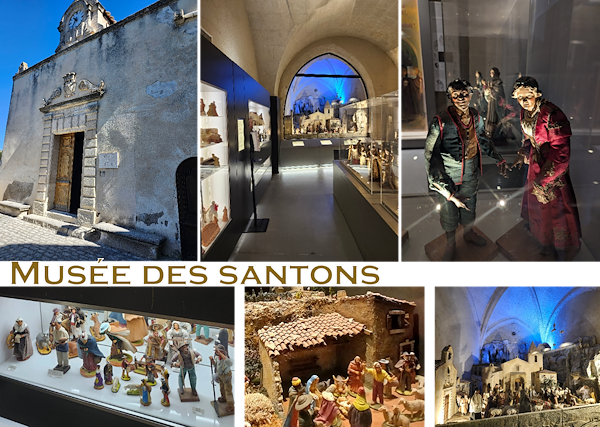
Located in the historic village of Les Baux-de-Provence, the Santons Museum is devoted to one of the most distinctive traditions of Provence: the art of the santons. These small hand-painted clay figurines are an essential element of the Provençal Christmas nativity scene and have become a beloved cultural symbol throughout southern France.
Beyond the biblical characters of the Nativity, santons represent the everyday life of a nineteenth-century Provençal village. Shepherds, craftsmen, fishermen, musicians, and market vendors are depicted in lively poses, symbolically making their way toward the stable where the Christ child is born. Through these figures, the nativity scene becomes a miniature representation of rural Provençal society.
A historic guardhouse
The museum is housed in a seventeenth-century guardhouse located on Place Louis Jou, near the Porte d’Eyguières, the historic main entrance to the fortified village.
Originally built to monitor and protect access to the village, the building served as a military post where soldiers controlled entry and ensured the security of the site. Its architecture reflects this defensive function, with thick stone walls and vaulted interior spaces.
Over the centuries, the building was adapted for various civic purposes. It served successively as a school, a courthouse, and even the town hall of Les Baux-de-Provence until the 1960s. In the basement, two former sixteenth-century prison cells remain from an earlier phase of the building’s history. These underground spaces, which were used as a jail until the French Revolution, are not accessible to visitors today.
Part of the structure was rebuilt in 1657, when the building was fitted with an elegant groin vault, characteristic of civil architecture of the period.
The art of Provençal santons
Provençal santons are small figurines made from fired clay, typically measuring between three and twelve centimeters in height. They are molded using traditional plaster molds, then hand-painted in bright colors such as ochre, blue, and green.
Many santons are made from clay originating in the region of Aubagne, a town famous for its long-standing santon-making tradition. Their expressive faces, often marked by wrinkles or cheerful smiles, and their carefully crafted costumes inspired by traditional Provençal clothing give these figures their distinctive personality.
In addition to biblical figures such as the Holy Family, the Magi, and the shepherds, the Provençal nativity scene includes many popular characters: the shepherd carrying a lamb, the tambourine player, the fishmonger, the potter, and the well-known “Ravi,” a joyful villager raising his arms in wonder.
A diverse collection
The museum displays a varied collection illustrating the richness of this craft tradition.
Among the works are santons created by renowned Provençal santon makers such as Marcel Carbonel, Jean-Louis Lagnel, Thérèse Neveu, and Louise Berger, whose creations have helped shape the development and popularity of santon art.
The collection also includes Neapolitan figurines from the seventeenth and eighteenth centuries, famous for their richly embroidered garments and expressive gestures, as well as nineteenth-century church santons produced by the Carmelite convent in Avignon. These figures are notable for their painted papier-mâché faces and glass eyes, which give them a particularly lifelike appearance.
Scenes of Provençal life
Several display cases recreate scenes inspired by local traditions. One of them illustrates the Pastrage, a traditional ceremony in which shepherds present offerings during the Christmas mass celebrated at the Église Saint-Vincent des Baux.
A large Provençal nativity scene also depicts daily life in a nineteenth-century household, while a small area designed for children presents colorful and simplified santons displayed at eye level for younger visitors.
At the museum entrance, a painting created in 1947 by the Provençal artist Antoine Serra represents the nativity scene during the traditional midnight mass, highlighting the cultural importance of this celebration in Provence.
A brief but enriching visit
Admission to the museum is free and it is open throughout the year. Although modest in size, it offers an engaging introduction to a living craft tradition deeply rooted in regional culture.
A short visit of about ten to fifteen minutes allows visitors to discover the artistry and symbolism of the santons while gaining insight into the everyday life and traditions of Provence.
 Simple Travel and Recreation